Last checked: 2026-11-11. Based on the Bank of Korea’s currency pages, the Bank of Korea Act and VISITKOREA. This page covers the money itself. For cards, ATMs, exchanging money and how much cash to carry, see our money in Korea guide.
Korean money is easy once you know two things: the notes get wider as they get more valuable, and prices are counted in units of ten thousand. This guide shows what each note and coin looks like, the Bank of Korea’s own quick checks for fake notes, what happens to a torn note, and how to read a price tag like 1.5만 원.
The short version
- Four notes: ₩1,000 (blue), ₩5,000 (red and yellow), ₩10,000 (green) and ₩50,000 (yellow). All are 68 mm tall; the higher the value, the wider the note.
- Watch the two yellowish notes. ₩5,000 and ₩50,000 are both warm-coloured. The ₩50,000 is the widest note and has five digits.
- Coins you’ll get as change: ₩10, ₩50, ₩100 and ₩500. ₩1 and ₩5 coins exist but hardly circulate.
- Older notes and the big old ₩10 coin are still money. The Bank of Korea says discontinued notes and coins can still be used and exchanged at face value.
- Fake check: hold it to the light, tilt it, feel the raised print.
- Torn note: under the Bank of Korea’s rules, three-quarters or more left gets full value and two-fifths or more gets half. Ordinary banks handle the easy cases.
- Prices: 천 (cheon) = 1,000 and 만 (man) = 10,000, so 1.5만 원 = ₩15,000 and 3천 원 = ₩3,000. There are no decimals.
The four banknotes
The Bank of Korea, the only issuer of money in Korea under the Bank of Korea Act, prints four notes. The current designs came out between 2006 and 2009.
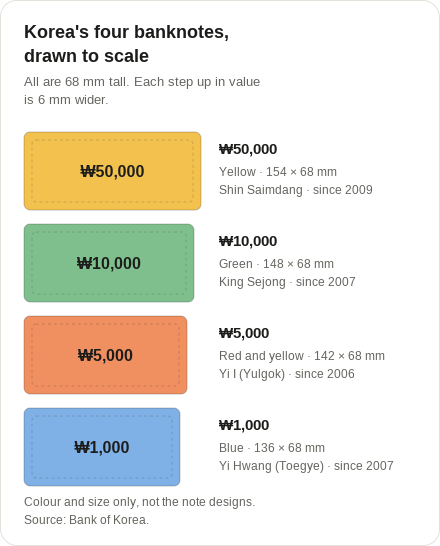
| Note | Colour | Size | Front | Back | Current design since |
|---|---|---|---|---|---|
| ₩1,000 | Blue | 136 × 68 mm | Yi Hwang (Toegye) | Gyesang Jeonggeodo, a landscape painting | January 22, 2007 |
| ₩5,000 | Red and yellow | 142 × 68 mm | Yi I (Yulgok) | An insects-and-plants painting (watermelon and cockscomb) attributed to Shin Saimdang | January 2, 2006 |
| ₩10,000 | Green | 148 × 68 mm | King Sejong the Great | Honcheonui, an armillary sphere | January 22, 2007 |
| ₩50,000 | Yellow | 154 × 68 mm | Shin Saimdang | Paintings of plum blossom (Wolmaedo) and bamboo (Pungjukdo), laid out vertically | June 23, 2009 |
The Bank of Korea also lists the other motifs on each note: Myeongnyundang hall and plum blossom (₩1,000), Ojukheon house and its black bamboo (₩5,000), the sun, moon and five peaks screen (Irworobongdo) and the Yongbieocheonga verses (₩10,000), and paintings of grapes and eggplant (₩50,000).
Who is on the notes
- Yi Hwang (Toegye, 1501–1570), ₩1,000: a Joseon-era Confucian scholar.
- Yi I (Yulgok, 1536–1584), ₩5,000: another Joseon-era scholar, born at Ojukheon in Gangneung, a house you can visit.
- King Sejong the Great (1397–1450), ₩10,000: the king who had his scholars create the Korean alphabet, Hangeul, in 1443.
- Shin Saimdang (1504–1551), ₩50,000: Yi I’s mother, so mother and son appear on two different notes.
Older notes
The current notes replaced earlier series of the ₩1,000, ₩5,000 and ₩10,000 notes. The Bank of Korea says notes and coins it no longer issues are still legal tender: they can circulate, and banks and the Bank of Korea exchange them at face value. You’re unlikely to be handed one, but if you are, it’s real money. (Notes withdrawn in Korea’s 1962 currency reform are a different matter and can’t be exchanged; you won’t meet them in a shop.)
Coins
| Coin | Design | Diameter | Edge |
|---|---|---|---|
| ₩10 | Dabotap pagoda | 18.0 mm | Plain |
| ₩50 | Ear of rice | 21.6 mm | Milled |
| ₩100 | Admiral Yi Sun-sin | 24.0 mm | Milled |
| ₩500 | Crane | 26.5 mm | Milled |
| ₩1 | Rose of Sharon (mugunghwa) | 17.2 mm | Plain |
| ₩5 | Turtle ship | 20.4 mm | Plain |
The small ₩10 coin. Since December 18, 2006, the ₩10 coin has been a small copper-clad aluminium coin: 18.0 mm across and 1.22 g, reddish because of its copper coating. The older ₩10 coin is larger (22.86 mm, 4.06 g, brass). When the small one came out, the Bank of Korea said the old coin would stay in use, so you may get both in your change.
₩1 and ₩5. These still appear in the Bank of Korea’s list of current coins, but the bank said in 2006 that they hardly circulate and cost more to make than they’re worth.
Spotting a fake note in three checks
The Bank of Korea asks people to make a habit of three checks: hold the note up to the light, tilt it, and feel it. Fakes made on colour printers usually fail at least one.
1. Hold it up to the light
- A hidden portrait (watermark) appears in the blank area. On the ₩1,000, ₩5,000 and ₩10,000 notes it’s the same person as the printed portrait, facing the other way. On the ₩50,000 it’s Shin Saimdang. The Bank of Korea says the details, such as which way the eyes look, differ slightly from the printed portrait on a real note; a fake often has no hidden portrait or an exact copy of the front one.
- Patterns printed on the front and back line up into a complete taegeuk (yin-yang) circle.
2. Tilt it
- Hologram: the ₩50,000 has a hologram strip on the left of the front, the ₩10,000 a square patch and the ₩5,000 a round patch. As you tilt, a map of Korea, the taegeuk with the value, and the four trigrams take turns. The ₩1,000 has no hologram patch; instead a strip shows through the paper at intervals, carrying the letters 한국은행 BOK.
- Moving strip (₩50,000 only): a grey-blue strip with taegeuk patterns that seem to move up and down or sideways as you tilt.
- Colour-changing number: ₩50,000, the number on the back at the upper right turns from magenta to green; ₩10,000 and ₩5,000, gold to green; ₩1,000, green to blue.
- Hidden letters: hold the note almost flat at eye level and a “5” (₩50,000) or “WON” (the other notes) appears in the pattern.
3. Feel it
The portrait, letters and numbers are printed in raised ink and feel slightly rough. The ₩50,000 also has five raised stripes at the middle of its left and right edges, so people with low vision can tell it apart.
If you think you’ve been given a fake, don’t spend it. The Bank of Korea says to handle it as little as possible (don’t photocopy it, which spoils fingerprints), put it in an envelope, try to remember who gave it to you, and report it to the police (112) or a bank.
Torn, burnt or damaged notes
The Bank of Korea replaces damaged money with good notes and coins and charges no fee. What you get depends on how much of the note is left:
| Area of the note left | You get |
|---|---|
| Three-quarters or more | Full value |
| Two-fifths or more, but less than three-quarters | Half the value |
| Less than two-fifths | Nothing |
- Pieces only count together if they come from the same note.
- Burnt notes: the remaining area is what counts, so don’t brush off the ash. Keep it in a box or container as it is.
- Coins: bent or rusty coins are swapped at full value, unless you can’t recognise them or tell if they’re genuine.
- Where: a note that’s easy to judge, such as one with a torn corner, can be changed at an ordinary bank (including NH Nonghyup, Suhyup and post offices). Badly damaged or burnt money goes to the Bank of Korea’s head office or one of its regional offices.
Reading prices
- Won: the currency unit set by the Bank of Korea Act, written 원 in Korean, WON in English, with the symbol ₩ (code KRW). The law divides a won into 100 jeon, but no jeon money is issued, and the smallest coin is ₩1. So prices are whole numbers: ₩4,500, 4,500원.
- 천 and 만: 천 (cheon) is 1,000 and 만 (man) is 10,000. Korean groups big numbers by 만, the National Institute of Korean Language explains, so you’ll see:
| Written | Means |
|---|---|
| 3천 원 | ₩3,000 |
| 1만 원 | ₩10,000 |
| 1.5만 원 or 1만 5천 원 | ₩15,000 |
| 12만 원 | ₩120,000 |
- Said aloud: prices use Sino-Korean numbers. ₩15,000 is 만 오천 원 (man ocheon won), “one man and five thousand”. Our Korean phrases tool has a number reader that says any amount aloud.
Practical tips
- Break big notes early. A ₩50,000 note is a lot to hand over for a ₩2,000 snack at a market stall. When you change money or use an ATM, it’s worth asking for or keeping some ₩10,000 and ₩1,000 notes. (This is our tip, not an official rule.)
- Check which note you’re handing over, especially ₩5,000 against ₩50,000. Width and the number of digits are the quickest tells.
- Leftover coins: the Bank of Korea’s rules for nonresidents turning won back into foreign currency talk about amounts, not coins, and we couldn’t find an official page saying exchange counters take coins. Plan to spend coins before you fly. Notes can be changed back; see the money in Korea guide. Coins don’t expire, so keeping them for your next trip works too.
What we could not confirm
- Whether bank or airport exchange counters will buy back won coins. We found no official statement either way.
- The current status of the Bank of Korea’s “coinless society” programme, which loaded change onto cards instead of giving coins. It was aimed at residents, and we couldn’t find a current official page, so we don’t describe it.
FAQ
How do I tell the ₩5,000 and ₩50,000 notes apart?
Both are warm-coloured. The ₩50,000 is yellow, the widest note (154 mm) and has five digits; the ₩5,000 is red and yellow and 12 mm narrower. The ₩50,000 also has a hologram strip down the left of the front, while the ₩5,000 has a small round hologram patch.
Are old Korean banknotes still valid?
Yes. The Bank of Korea says notes and coins issued since the 1962 currency reform that it no longer prints are still legal tender and are exchanged at face value at banks and the Bank of Korea. Only notes withdrawn in the 1962 reform can’t be used or exchanged.
Can I change Korean coins back into my own currency?
We couldn’t find any official page saying exchange counters accept coins, so don’t count on it. Spend coins before you leave, or keep them for your next trip; Korean coins don’t expire.
What does 만 mean on a price tag?
만 means 10,000. 2만 원 is ₩20,000 and 1.5만 원 is ₩15,000. 천 means 1,000, so 5천 원 is ₩5,000.
A shop gave me a torn note. Is it still worth anything?
If three-quarters or more of it is left, you can swap it for a good note at full value. Between two-fifths and three-quarters, you get half. A note with just a torn corner can be changed at an ordinary bank; the Bank of Korea’s own offices handle badly damaged money and charge no fee.
This is an unofficial guide based on Bank of Korea and other official pages. We’re not affiliated with the Bank of Korea or any bank. The note chart shows colours and sizes only and doesn’t reproduce the banknote designs.