Last checked: 2026-11-10 (Climate Card on AREX, all-stop travel times, KSPO airport buses and T2 taxi stands rechecked 2026-11-20). Fares and timetables below are as of November 2026 and taken from official operator pages. They change, so check the linked official site before you travel.
You’ve landed at Incheon with a suitcase, and the concert is in two days (or a few hours, if your flight was late). Your options are the AREX airport train, airport buses, taxis and late-night buses. The best one depends on when you land, how much luggage you have, and where in Seoul you’re going.
Quick comparison
| Option | Typical cost (adult, as of Oct 2026) | Time to central Seoul | Best for |
|---|---|---|---|
| AREX Express train | ₩13,000 to Seoul Station | 43 min from T1, 51 min from T2 | Staying near Seoul Station, guaranteed seat |
| AREX All-stop train | ₩4,750 (T1) / ₩5,350 (T2) to Seoul Station with a transit card | About 59 min from T1, 66 min from T2 (VISITKOREA) | Budget, Hongdae, Gongdeok, or connecting to the subway |
| Airport bus | Roughly ₩16,000–18,000 on Seoul routes | Depends on traffic and route | Door-to-hotel-area with luggage, no transfers |
| Taxi | Metered, plus tolls and surcharges | Depends on traffic | Groups, heavy luggage, very late arrivals |
| Late-night bus | ₩17,000–18,000 on main Seoul routes | About 70–90 min | Landing after the trains stop |
AREX: express vs all-stop
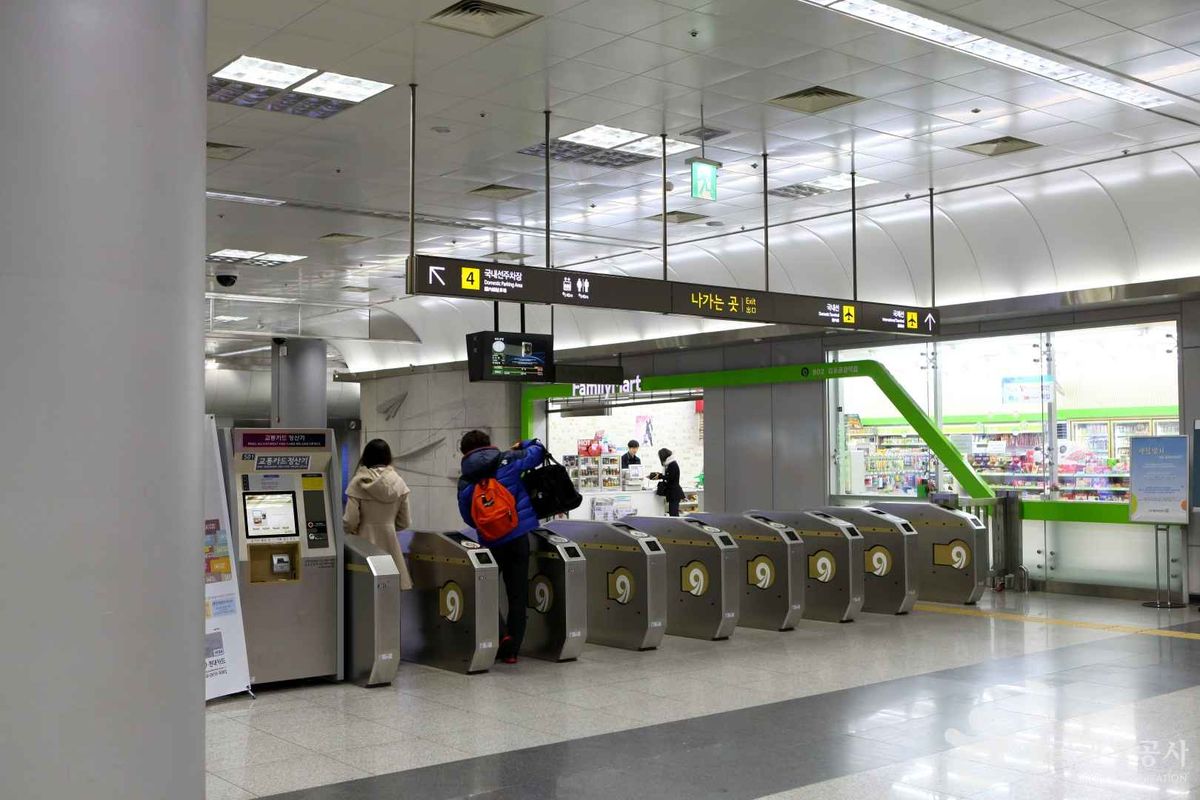
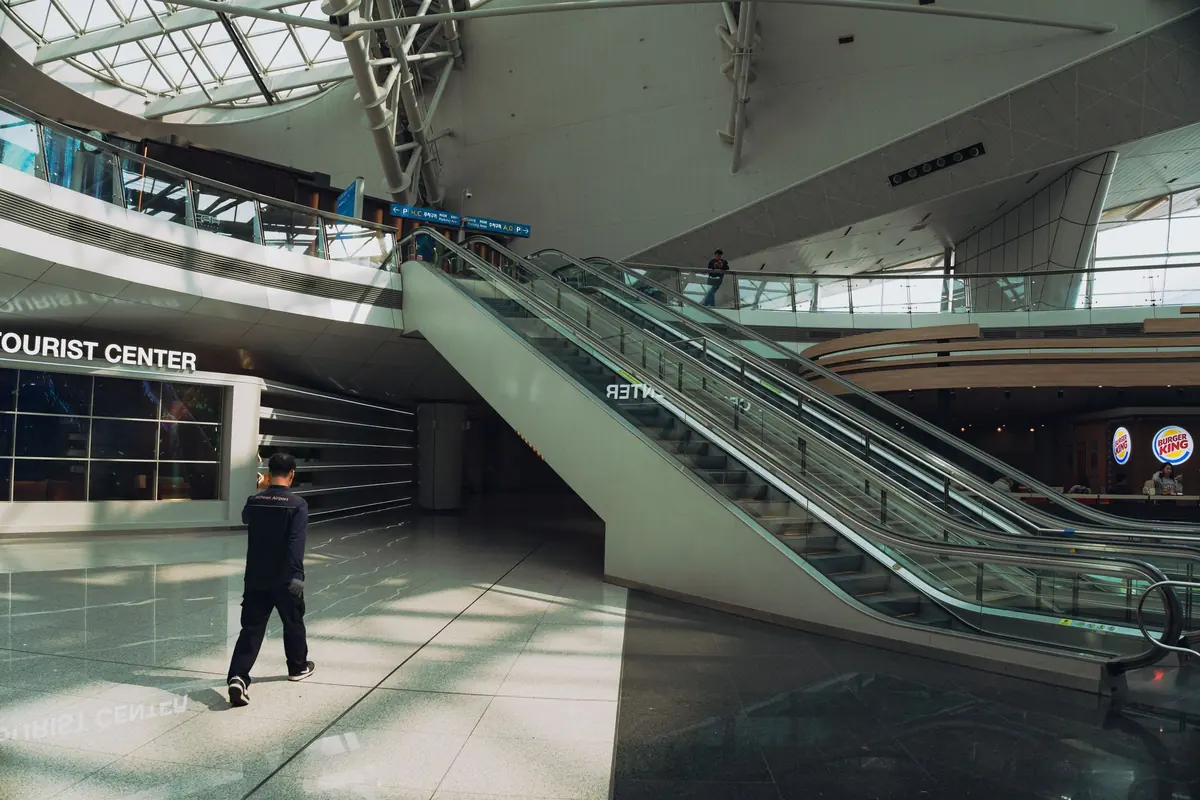
AREX (Airport Railroad) connects both Incheon terminals with Seoul Station. Inside the airport, follow the signs to the Transportation Center on Basement 1 (B1) in either terminal. Ticket machines and an information desk are there.
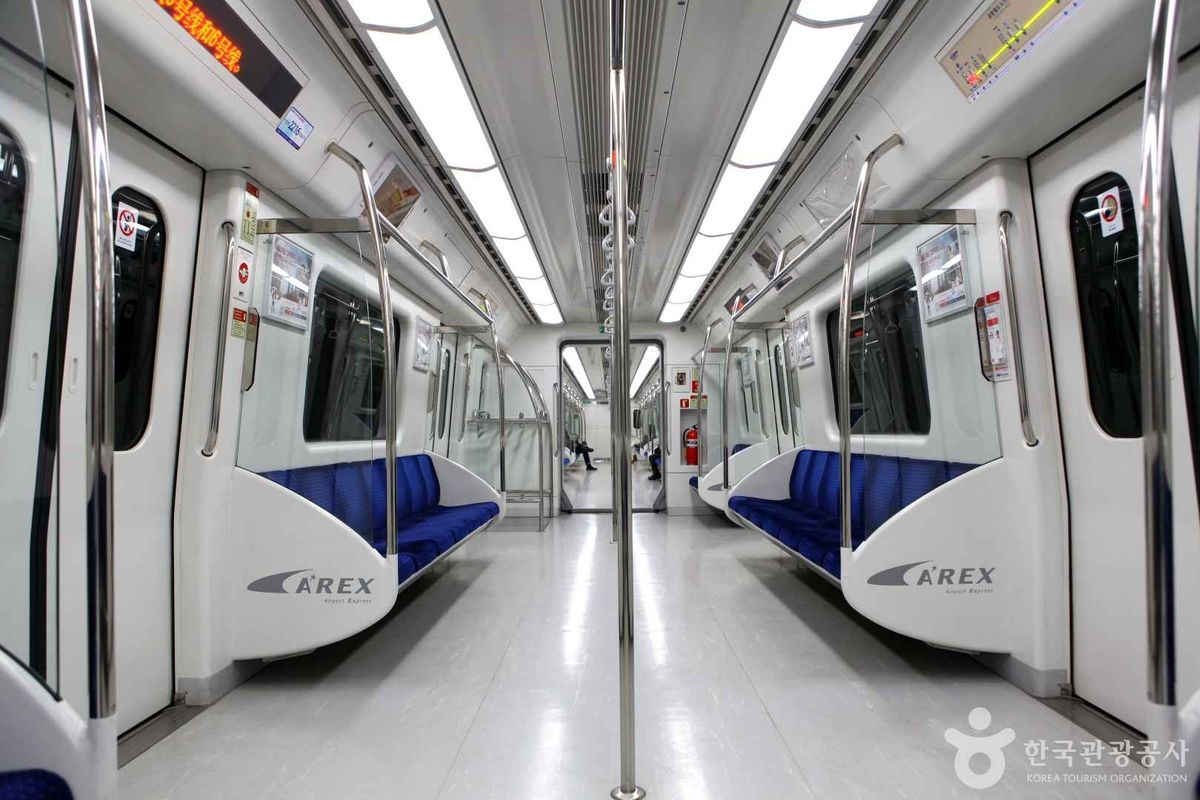
AREX Express train
- Route: Non-stop between Incheon Airport and Seoul Station. It does not stop anywhere in between.
- Travel time: AREX lists 43 minutes from Terminal 1 and 51 minutes from Terminal 2.
- Fare: AREX’s official page lists the adult express fare as ₩13,000, with ₩9,500 for children. It also shows a higher “regular fare” (₩18,500 to T1, ₩19,100 to T2), which is not what you’ll normally pay. As of October 2026 the ₩13,000 fare is the one advertised.
- Seats: Reserved seating, so you get a seat with space near your bags.
- Ticket: You need a separate express ticket before boarding. A transit card tap is not enough.
- Hours: On the official weekday timetable, the first express leaves T2 at 05:16 (T1 at 05:24). The last one toward Seoul leaves T2 at 22:40 (T1 at 22:48). Trains run roughly every 30–65 minutes, not every few minutes, and the express uses the same timetable on weekdays and weekends.
The express makes most sense if you’re staying near Seoul Station. If your hotel is in Hongdae, Gangnam or near a venue, you’ll transfer anyway, so it saves less time than you’d think.
AREX All-stop train
- Route: Stops at every station, including Gimpo Airport (transfer to Lines 5 and 9), Digital Media City, Hongik University (Hongdae, Line 2), Gongdeok, and Seoul Station.
- Fare (as of Oct 2026, official AREX fare table): ₩4,750 from T1 and ₩5,350 from T2 to Seoul Station with a transit card. A single-use ticket costs ₩100 more, plus a ₩500 deposit that you get back at your arrival station.
- Travel time: Incheon Airport’s own route map shows about 66 minutes from T2 to Seoul Station. From T1 it’s a few minutes less.
- Payment: Tap a T-money–type transit card, or buy a single-use ticket at the machines.
For most concertgoers the all-stop is the practical choice: it costs about a third of the express and connects straight into the subway.
Getting to the main concert venues
These are typical routes, not the only ones. Use Naver Map or KakaoMap on the day, because they show live connections.
| Venue | Area | Typical public transport from the airport |
|---|---|---|
| KSPO Dome | Olympic Park, Songpa-gu | AREX all-stop to Gimpo Airport, then Line 9 or Line 5 to Olympic Park Station. Olympic Park’s official transport page lists airport buses 6200 (Olympic Hall stop) and 6300 (Olympic Athletes’ Village Apartments stop). |
| Gocheok Sky Dome | Guro-gu, southwest Seoul | AREX to Seoul Station, then Line 1 toward Incheon (not the Cheonan/Sinchang branch) to Guil Station. |
| Inspire Arena | Yeongjong Island, near the airport | Close to the airport itself. Resort and event shuttles change by event, so check the venue guide and your ticket page. |
Venue maps
Each venue guide has a directions map with the station exit, a walking route and a table of routes from the airports, Seoul Station, Myeongdong, Hongdae and Gangnam. Each also has a line in Hangul to show a taxi driver.
- KSPO DOME directions map: Olympic Park Station Exit 3
- Ticketlink Live Arena, Olympic Hall and Woori Financial Art Hall: Olympic Park Station Exit 3
- Seoul World Cup Stadium: World Cup Stadium Station Exit 2
- Gocheok Sky Dome directions map: Guil Station Exit 2
- Inspire Arena directions map: Cargo Terminal Station Exit 2 and resort shuttles
Flying in on concert day? Immigration, baggage claim and the trip into Seoul can take two to three hours together. Leave margin for merch lines and ticket pickup as well.
Airport buses (limousine buses)
Airport buses run from the arrivals curb to dozens of Seoul neighborhoods, so you can skip subway transfers with a big suitcase.
- Where to board: At Terminal 1, Incheon Airport lists Seoul-bound buses outside exits 3–7 on the arrivals floor. Terminal 2 has its own bus stop guide on the airport site.
- Tickets: At T1 there are ticket booths inside the terminal next to exits 4 and 9, and outside near several exits. Many routes also have ticket machines.
- Cost: The two main Seoul operators list adult fares of ₩17,000 (Airport Limousine, 6001–6019 routes; ₩16,000 on routes via Gimpo Airport) and ₩18,000 (Korea Airport Limousine, 6701–6705 routes) as of October 2026. Other routes can differ, so check at the counter.
- Routes: Incheon Airport’s bus search lists Seoul routes such as 6001 (Dongdaemun), 6002 (Cheongnyangni), 6006 (Jamsilsaenae), 6015 (Myeongdong), 6103 (Samseong/City Airport), 6703 (Gangnam/COEX) and 6705 (Jamsil/East Seoul).
Buses get stuck in traffic. At rush hour or on a concert night, the train is more predictable.
Taxis
Use the official taxi stands only. Incheon Airport specifically warns that unofficial “call van” drivers soliciting in the terminal are often illegal and overcharge.
- Standard taxis: The base fare is ₩4,800 (as of Oct 2026, per Incheon Airport). At T1, Seoul-bound standard taxis board at 5C, 6C and 6D. At T2 they board at 7C, according to the airport’s fare and stand table. The T2 map on the same page marks Seoul-bound taxis at 5C and international taxis at 1C instead, so follow the signs in the terminal.
- Deluxe/jumbo taxis: Higher base fare (₩7,000). Larger vehicles, useful for groups with luggage.
- International taxis: Official taxis with foreign-language-speaking drivers and a flat fare within Seoul. At T1 they board at 4C, and at T2 at 3C.
- Night surcharge: Seoul taxis add 20% from 22:00–23:00, 40% from 23:00–02:00, and 20% from 02:00–04:00 (airport figures as of Oct 2026).
- Tolls: Highway tolls are generally added to the meter, so the total is more than the meter alone.
A taxi costs far more than the train, but split three or four ways late at night it can be reasonable.
Late-night arrivals
Flights landing after about 22:30 are the tricky ones, because the last AREX express toward Seoul leaves T1 at 22:48. All-stop trains run later, to around midnight, but check the final departure on AREX’s timetable for your terminal and date.
After that, Incheon Airport lists these Seoul late-night bus routes (as of October 2026):
| Route | Main stops | First / last departure from T1 | Adult fare |
|---|---|---|---|
| N6000 | Songjeong, Yeomchang, Gangnam Express Bus Terminal | 00:10 / 04:20 | ₩17,000 |
| N6002 | Hongdae, Heunginjimun (Dongdaemun), Cheongnyangni | 00:00 / 04:40 | ₩17,000 |
| N6701 | Mapo, Seoul Station, Euljiro, Dongdaemun Design Plaza | 23:50 / 04:40 | ₩18,000 |
| N6703 | Seorae Village, COEX, Jamsil Lotte World, Gangbyeon, Gwangnaru | 23:40 / 04:50 | ₩18,000 |
Gaps between departures range from about 30 minutes to more than two hours, so check the exact timetable. Tickets are sold at ticket booths and automated machines, and for N6701 and N6703 also through the Tmoney GO app. Older night routes such as N6001 no longer appear on the airport’s list, so don’t rely on old blog timetables.
Transit cards: what works for visitors
T-money style rechargeable card
The standard option is a rechargeable transit card (T-money or a compatible card). You tap it on subway gates and buses, including the AREX all-stop. You can buy one at convenience stores and subway stations. Plan to top it up with cash, since card top-ups aren’t accepted everywhere.
Climate Card short-term pass
Seoul’s Climate Card (기후동행카드) short-term passes give unlimited rides on Seoul subway and buses for a set period. The Seoul government’s FAQ (checked October 2026) says:
- The 30-day Climate Card ended on October 1, 2026.
- Short-term passes of 1, 2, 3, 5 and 7 days are still available, valid within Seoul.
- The 7-day pass is listed at ₩20,000. Shorter passes cost less. Check the current price at the machine.
A short-term pass suits fans riding the subway several times a day. It’s designed for travel within Seoul. On AREX, the Seoul government says you can board at the six Seoul-section stations (Seoul Station, Gongdeok, Hongik Univ., Digital Media City, Magongnaru and Gimpo Airport) and, since October 1, 2026, get off at Incheon Airport T1 and T2. You can’t board at the Incheon Airport stations, so pay for the arrival-day trip from the airport into Seoul separately with a transit card balance or a ticket.
Paying with a foreign card at subway machines
Since March 17, 2026, the Seoul government says newer ticket machines at 273 stations on Lines 1–8 accept foreign-issued Visa, Mastercard and similar cards. You can buy single-use tickets and Climate Card short-term passes this way. There is an average service fee of about 3.7%. The change covers ticket machines only; tapping a foreign credit card directly at the gate was not part of it.
What about K-Pass?
K-Pass is a fare-refund program for people who live in Korea. It’s tied to Korean payment cards and phone numbers, so it isn’t practical for short-term visitors.
Arrival checklist
- Note your terminal (T1 or T2). Fares, times and boarding spots differ.
- Get some Korean won in cash for transit card top-ups and small purchases.
- Download Naver Map or KakaoMap and save your hotel and venue before you fly.
- If you land after 22:30, check the last AREX train and the late-night bus timetable.
- Use official taxi stands only, never drivers approaching you inside the terminal.
- Convert your flight and concert times with our KST converter so you don’t misjudge the day.
- Read our phone, data and payments guide before you go.
FAQ
Is the AREX Express worth it for a K-pop trip?
Only if you’re staying near Seoul Station or arriving with a lot of luggage and want a reserved seat. For Hongdae, Gangnam, Jamsil or Olympic Park, the all-stop train plus a subway transfer is usually about as fast and costs much less.
Can I use a transit card on the AREX Express?
No. The express needs its own ticket, bought before boarding. The all-stop train works with a tap of a rechargeable transit card.
How do I get from Incheon Airport to KSPO Dome?
AREX all-stop to Gimpo Airport, then Line 9 or Line 5 to Olympic Park Station. Airport buses to Jamsil/Songpa avoid the transfer. See our KSPO Dome guide.
My flight lands at midnight. What are my options?
Seoul late-night buses (N6000, N6002, N6701, N6703) run from around midnight to early morning, as of October 2026. Official taxis and international taxis are the other choice. Expect a night surcharge on taxis.
Is the Climate Card still available for tourists?
Yes. As of November 2026 the Seoul government says the 1-, 2-, 3-, 5- and 7-day short-term passes continue. Only the 30-day pass ended. On AREX it covers boarding at the Seoul-section stations and getting off at Incheon Airport T1 and T2, but not boarding at the airport.
Can I pay for the subway with my foreign credit card?
At newer ticket machines on Lines 1–8, yes, for single tickets or a Climate Card short-term pass (with a service fee). You can’t tap it at the gates yet.
This is an unofficial fan guide and isn’t affiliated with any airport, transit operator, venue or artist. Always confirm fares and timetables on the official sites linked above.