Last checked: 2026-10-18, against the Incheon International Airport Corporation, Korea Airports Corporation and VISITKOREA pages listed below. Terminals, counter hours and services change. Confirm with your airline and your e-ticket before you leave for the airport.
The day you fly out of Korea is easy to get wrong. The two questions that trip up the most travelers are which terminal at Incheon Airport your flight leaves from, and how early you should arrive. The short answer to the first is that the terminal is set by your airline and flight, so your ticket is the thing to check. The airport corporation’s pages explain the whole departure routine, gate numbers and moves between terminals in detail, and we have put that in one place. We also cover Gimpo Airport, the smaller airport closer to central Seoul. For arrivals and for travelers changing planes at Incheon, our Incheon layover guide covers transit rules and free tours, so this guide sticks to leaving Korea and to the choice between Incheon and Gimpo.
The short version
- Terminals are assigned by airline. The airport’s official list places Jeju Air, Trinity Airways, Eastar Jet, Air Premia, Jetstar, Peach Aviation, ZIPAIR, AIR JAPAN, Lufthansa and AirAsia X in Terminal 1 (T1), and Korean Air, Asiana, Jin Air, Air Seoul, Air Busan, Delta and China Airlines in Terminal 2 (T2).
- We could not confirm the terminals for Japan Airlines or ANA. In the airport’s list, those two appear only under cargo, not under passenger terminals. Codeshare flights can also use a different terminal than the airline you booked with, so check your e-ticket.
- No single “arrive X hours early” number appeared on the official pages we read. The facts we found are that foreign airlines open counters 3 to 2 hours before departure, and the airport asks passengers to reach the boarding gate 30 to 40 minutes before departure. Our own planning rule, built from these facts, is two to three hours before an international flight.
- Airport fees are normally already in your ticket. The ₩17,000 airport facility fee and ₩7,000 tourist departure tax are collected when a ticket is issued.
- Gimpo is much closer to central Seoul. The Airport Railroad all-stop train takes about 23 minutes from Gimpo to Seoul Station, against 59 to 66 minutes from Incheon, per VISITKOREA. Gimpo has far fewer airlines.
Incheon: finding your terminal
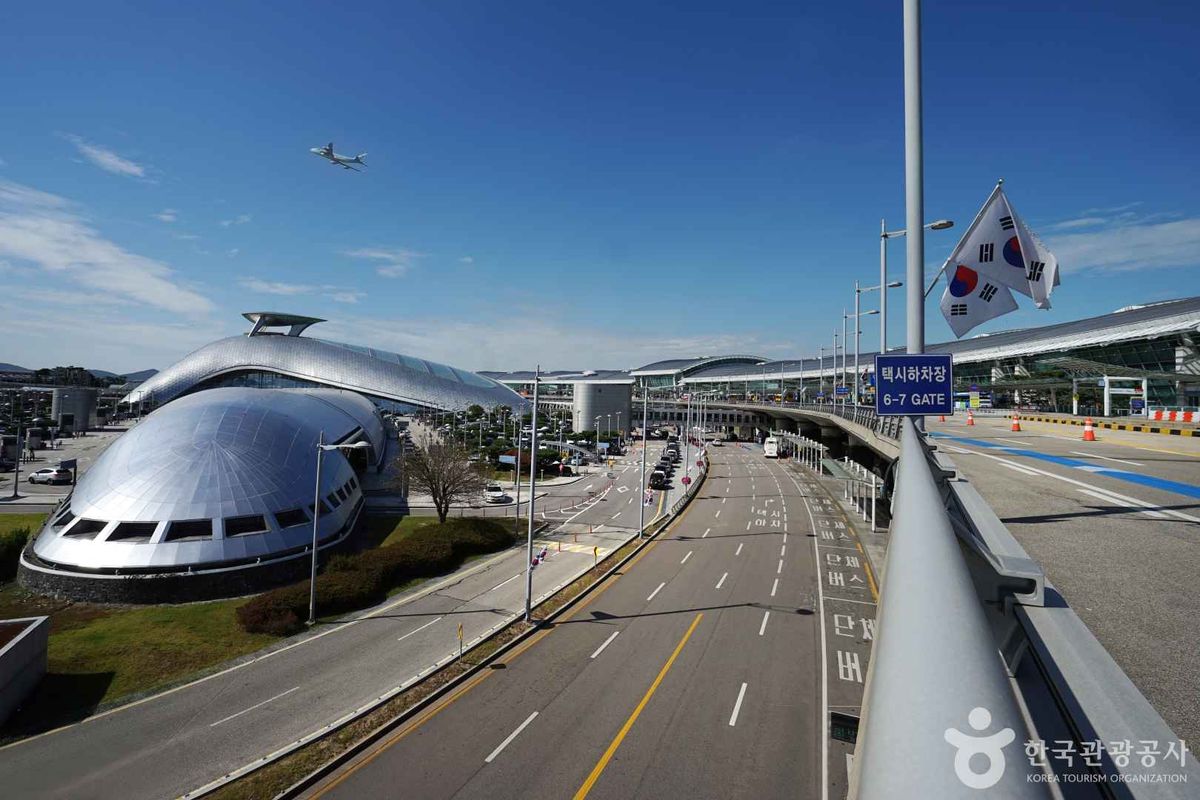
Incheon has two passenger terminals, and the departure hall is on the third floor in both. The airport corporation’s departure page lists airlines by terminal:
| Terminal | Airlines named on the airport’s list (examples) |
|---|---|
| Terminal 1 (T1) | Jeju Air, Trinity Airways, Eastar Jet, Air Premia, Jetstar, Peach Aviation, ZIPAIR, AIR JAPAN, Lufthansa, AirAsia X, EVA Air and many other foreign carriers |
| Terminal 2 (T2) | Korean Air, Asiana Airlines, Jin Air, Air Seoul, Air Busan, Delta, KLM, Air France, China Airlines and others |
The page warns that the actual terminal can change because of codeshare flights or airline circumstances, and tells passengers to confirm on the e-ticket or in the airport’s flight search. In practice, a codeshare can mean that the airline you booked is not the one that operates the aircraft, so the airline’s name alone is not enough. Confirm in three places:
- Your e-ticket or check-in email, which should name the terminal.
- The flight search on the Incheon Airport website or app (departures), by flight number.
- The departure-hall information screens (FIDS) after you arrive, to find your check-in counter letter.
T1 and T2 are linked by the Airport Railroad, which takes 6 minutes and costs ₩1,050, according to the airport corporation. If you go to the wrong terminal you can still fix it, but it is a mistake you want to avoid when time is short.
The departure routine at Incheon
The airport corporation describes eight steps:
| Step | What happens | Detail from the official page |
|---|---|---|
| 1 | Arrive at the terminal | Departure hall on the 3rd floor |
| 2 | Check in and drop bags | Staffed counters, self check-in, self bag drop, web or mobile check-in |
| 3 | Customs declaration, tax refund | Only if needed |
| 4 | Pre-departure errands | Currency exchange, cash, roaming, insurance |
| 5 | Security screening | At the departure hall entrance |
| 6 | Immigration | Automated gate or staffed booth. After you enter the duty-free area you cannot return to the general area |
| 7 | Go to the gate | Gates 1 to 50 in T1, 101 to 132 in the concourse, 208 to 290 in T2 |
| 8 | Board | Reach the gate 30 to 40 minutes before departure |
The concourse gates (101 to 132) are reached by a shuttle train from T1 that runs 24 hours, and the airport says you cannot return once you have gone. If your T1 flight leaves from a 100-series gate, allow for that ride.
How early to arrive
The numbers we could confirm:
| Item | What the airport says |
|---|---|
| Foreign airlines’ counters | Open 3 to 2 hours before departure |
| Korean Air counters (T2) | Open from 5:30 |
| Asiana counters (T2) | Open from 5:00 |
| Self check-in and bag drop kiosks | The airport’s summary lists 24-hour use, with a cutoff of 1 hour before departure. Individual airlines publish their own hours |
| Boarding gate | Be there 30 to 40 minutes before departure |
These vary by airline and flight, so the airline’s own instruction comes first. Because we found no official blanket figure, our rule of two to three hours before an international departure is a planning suggestion. Arrive earlier if you are checking a bag, claiming a tax refund or flying from a 100-series gate.
Check the crowd forecast
The airport publishes a congestion forecast by hour for each terminal. It updates daily at 17:00 with departures expected two days ahead, so you can see whether your morning or evening looks busy before choosing when to leave your hotel.
Bags and quicker ways to check in
Carry-on size. For economy class, the airport describes a typical limit of 55 × 40 × 20 cm, with the three sides adding up to 115 cm or less, and 10 to 12 kg. Airline and cabin class rules differ, so follow your airline.
Self bag drop. In T1 it covers airlines such as Cathay Pacific, Turkish Airlines, Jeju Air, Trinity Airways, Eastar Jet, Air Premia and United, and in T2 Korean Air, Asiana, Jin Air, Air Seoul, Air France, KLM, Delta, China Airlines, Air Busan and others. Passengers needing visas for the destination, codeshare flights and some travelers with young children are not eligible.
Smart Pass. You register your passport, face and boarding pass in advance and then use face recognition at the departure-hall entrance and at some boarding gates. The face registration lasts five years, but boarding pass information has to be registered for each trip (for some airlines it is automatic at check-in). The service is open from age 7, with consent from a guardian under 14. The airport says the list of airlines and gates will expand in stages, so it is not available for every flight.
Off-airport check-in. Two options let you drop bags before reaching the airport:
- Easy Drop costs ₩35,000 per bag and handles check-in and baggage drop at city locations (a Myeongdong store, the Holiday Inn Express Seoul Hongdae lobby, the Samseong Station City Airport Terminal and two resort hotels near the airport). It covers seven airlines (Korean Air, Asiana, Jeju Air, Trinity Airways, Cathay Pacific, Eastar Jet and Jin Air) on international routes except the United States, and Korean Air and Asiana passengers must have checked in online. Each location has its own hours and deadlines, from 2 to 5 hours before departure, and the pages list Wednesdays and holidays as closed days.
- City Airport Terminal lets you check in, drop bags and clear immigration before heading to the airport. At Seoul Station (basement 2 of the Airport Railroad station) it is open 5:20 to 19:00 for check-in and drop-off, but only for travelers using the express train, with a deadline of 3 hours before departure for T1 flights and 3 hours 20 minutes for T2. The Gwangmyeong Station terminal (06:30 to 17:00 for check-in) can be used by anyone leaving from Incheon, though immigration is done at Incheon, not at the station.
The Airport Railroad page also describes T-Luggage, a Seoul Metro service for same-day suitcase delivery between subway stations and the airport, with reception desks on the 3rd floor of T1 (opposite check-in counter B) and T2 (opposite counter H).
The airport to-do list
| Task | What to check |
|---|---|
| Tax refund | Ask for a refund receipt and documents when you shop (the airport mentions purchases of ₩15,000 or more). Keep the goods and papers in your hand luggage, not your checked bag. If the kiosk flags you for a customs check, take the goods, passport and sales confirmation to the customs counter for a stamp. Counters are open 7:00 to 22:00 in T1 and 7:00 to 21:30 in T2, and kiosks 24 hours. See tax refunds in Korea |
| Large baggage | Counters on the 3rd floor of each terminal take oversized bags (over 50 kg, or beyond 45 × 90 × 70 cm), with customs declaration |
| Leftover won | Exchange at the airport or at home. See money in Korea |
| Duty-free purchases | Follow the store’s pickup instructions. We did not confirm pickup locations for T2 |
| Gate number | Check your boarding pass after immigration. 100-series gates are in the concourse |
For immigration, the airport says foreign short-stay visitors aged 17 or over can use the automated gates without registering. At the gate you scan the photo page of the passport, give your fingerprint and face the camera. At a staffed booth, take off hats and sunglasses and avoid phone calls. At security, the airport lists the same steps as most airports: show your passport and boarding pass, put everything in a tray and walk through the scanner.
Do I pay airport fees separately?
Normally no. The airport corporation says an international airport facility fee (₩17,000 per departing passenger, ₩10,000 for transfer passengers) and an international tourist departure tax (₩7,000) are collected when the ticket is issued. Children under two are exempt. If your ticket price shows a line for taxes and charges, those are probably inside it, and the booking receipt will tell you.
On the day you arrive
After immigration, check the screens for your baggage belt, take the elevator or escalator to the 1st floor, and use the oversized baggage lane for large items. For entry paperwork, see the K-ETA guide and the e-Arrival Card guide.
To get to Seoul, the Airport Railroad is the simplest. VISITKOREA gives express (non-stop) times to Seoul Station of about 43 minutes from T1 and 51 from T2, and all-stop times of about 59 minutes from T1 and 66 from T2. For subway payment, see the T-money guide, and for taxis, taxis in Korea. If your destination is a concert venue, the Incheon to Seoul concert venues guide lists routes.
Gimpo Airport: the other option
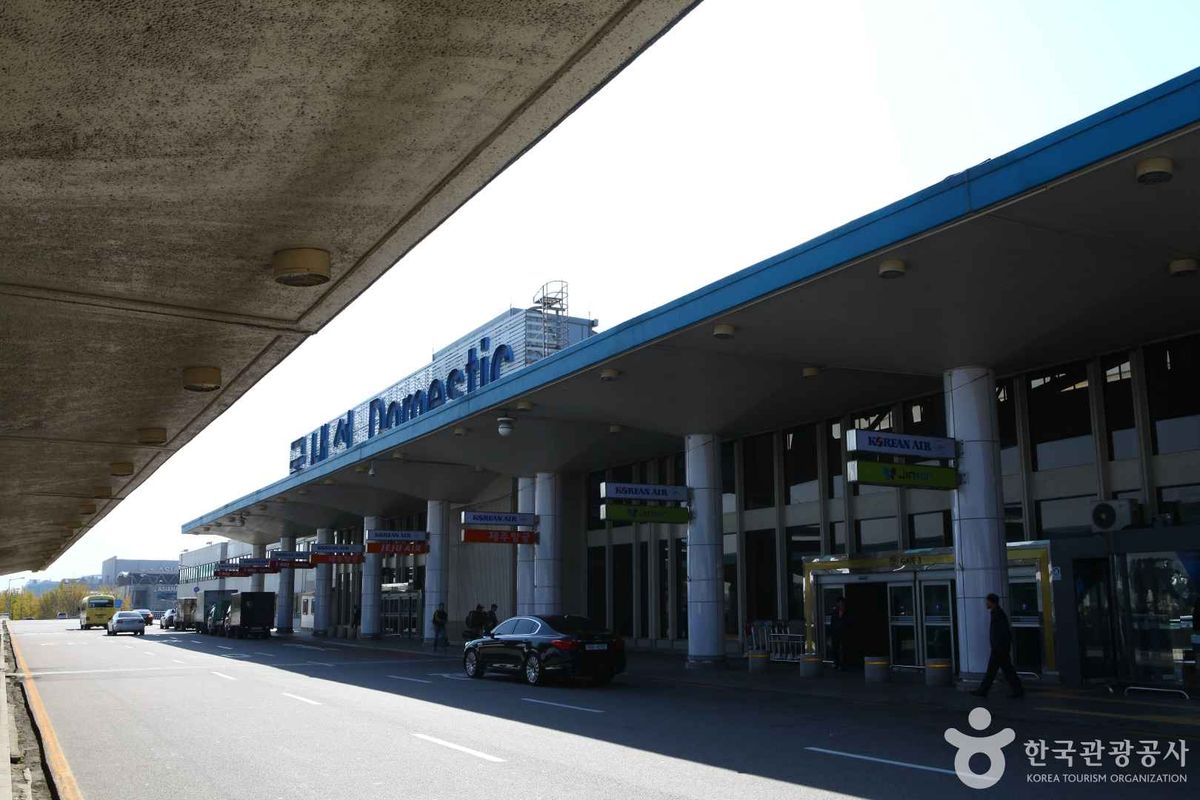
Gimpo is on the west side of Seoul. The Korea Airports Corporation’s list of airlines whose international flights can use the quick check-in kiosks at Gimpo names Korean Air, Asiana, T’way Air, Jeju Air and ANA, with no update date on the page. We could not find an official list of Gimpo’s international routes, so confirm that a flight on your dates exists before building a plan around it.
| Point | Incheon | Gimpo |
|---|---|---|
| To Seoul Station on the all-stop Airport Railroad | About 59 minutes (T1) or 66 minutes (T2) | About 23 minutes |
| Ways into the city | Airport Railroad, limousine bus, taxi | Subway Lines 5 and 9, the Airport Railroad, Gimpo Goldline, Seohae Line, buses, taxi |
| Terminals | Two passenger terminals, split by airline | International and domestic terminals |
| Airlines | A very long list | Fewer. The kiosk list names five for international flights |
Source for the times: VISITKOREA, updated May 22, 2026, and the airport corporations.
A free circulation bus links Gimpo’s international and domestic terminals. The stops are number 5 (international) and number 8 (domestic). The page lists 6:00 to 23:00 for the version that includes the cargo terminal and 8:00 to 23:00 (every 12 to 15 minutes) for the passenger-only version, but the page has no date, so check the posted notice at the airport. The airport corporation’s Airport Railroad line map counts minutes cumulatively from T2 and shows T1 at 6 minutes and Gimpo at 44 minutes, which suggests roughly 38 minutes from T1 by our subtraction.
FAQ
Which terminal do I depart from at Incheon, T1 or T2?
It depends on your airline and flight. The official list has Peach Aviation, ZIPAIR and Jetstar in T1, and Korean Air, Asiana and Jin Air in T2. We could not confirm JAL or ANA from the list. Check your e-ticket and the Incheon flight search.
What if I go to the wrong terminal?
T1 and T2 are 6 minutes apart on the Airport Railroad (₩1,050). Before security you can still move, but if time is short, ask your airline’s counter staff as early as possible.
How many hours before my flight should I arrive?
The official pages we read do not give one number. Foreign airlines’ counters open 2 to 3 hours before departure, and you must reach the gate 30 to 40 minutes before. Follow your airline’s instruction first. If it does not give one, two to three hours is our planning suggestion. Allow more if you check a bag, claim a tax refund or use a gate in the 100s.
Is Gimpo or Incheon better?
It depends on your flight and where you are staying. Gimpo is about 23 minutes from Seoul Station on the all-stop train, but few airlines fly from it. Check whether a flight exists on your dates before comparing hotel distances.
Where do I pick up duty-free goods?
Use the instructions given by the store where you bought them. We could not confirm the pickup point in T2 on the official pages.
Do I pay the departure tax in cash at the airport?
Normally not. The airport facility fee and tourist departure tax are collected when the ticket is issued. Check the tax and charge lines of your booking receipt.
This is an unofficial guide based on official information. It is not affiliated with Incheon International Airport Corporation, the Korea Airports Corporation or any airline. Terminals, hours and fees change, so check your ticket and the airport’s official notices before you travel.