Last checked: 2026-10-27 (the Climate Card 30-day end dates and the T-money refund rules were re-read on that date; other sections were last checked 2026-10-10). Fares, card rules and pass prices below are as of October 2026 and come from Seoul city and T-money pages. They change, so check the official links before you rely on a number.
Seoul’s subway and buses are cheap and frequent. The catch for visitors is payment: you can’t tap a foreign credit card at the gate, and some machines still want cash. Here’s what to buy, what rides cost, and how transfers keep the price down.
Quick answer
Buy a T-money card at a convenience store (roughly ₩3,000–5,000) and load ₩10,000–20,000 in cash. A subway ride costs ₩1,550 for up to 10 km, and you tap on and off every time. If you stay inside Seoul and need a card anyway, seven or more rides over three days makes a 3-day Climate Card (₩10,000, plus a ₩3,000 card) cheaper than T-money with a new card. If you already hold a T-money card, it takes nine. The worked examples below show the sums.
Arriving at Incheon? Our airport-to-Seoul guide covers AREX trains and airport buses. For SIM cards and paying in shops, see phone data and payments.
Your options at a glance
| Option | What it is | Best for |
|---|---|---|
| T-money card | Rechargeable card you tap on subways and buses | Almost everyone; works beyond Seoul too |
| Climate Card short-term pass | Unlimited Seoul subway and bus rides for 1–7 days | Many rides a day inside Seoul |
| Single-journey ticket | One-ride card from a station machine | One-off trips; costs more per ride |
| T-money on iPhone | Transit card on your iPhone or Apple Watch, topped up with Apple Pay in Tmoney’s app | iPhone users with a Mastercard, Amex, UnionPay or JCB card |
| Tourist-focused prepaid cards | Transit card plus shop payments, topped up with foreign currency | People who want to carry little cash |
Buying a T-money card
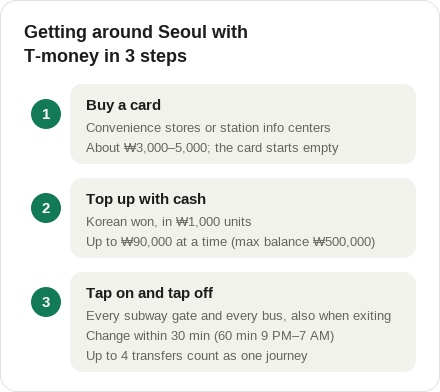
- Where: Convenience stores (GS25, CU, 7-Eleven and similar chains) and information centers in Seoul subway stations. VISITKOREA lists the card price as roughly ₩3,000–5,000 depending on the design.
- The card is empty. The purchase price is just for the card. You load ride money separately.
- The card price isn’t refunded when you leave. Only the remaining balance is.
T-money also sells visitor versions. Its official page lists the TMONEY TRAVEL CARD at ₩4,000, sold at convenience stores and the bus ticket office at Incheon Airport, covering buses, subways, taxis, and airport and express buses. A ₩6,000 “plus” version adds a separate payment wallet. For rides alone, a standard card does the same job.
Topping up (charging)
T-money’s guide for foreigners describes top-ups like this:
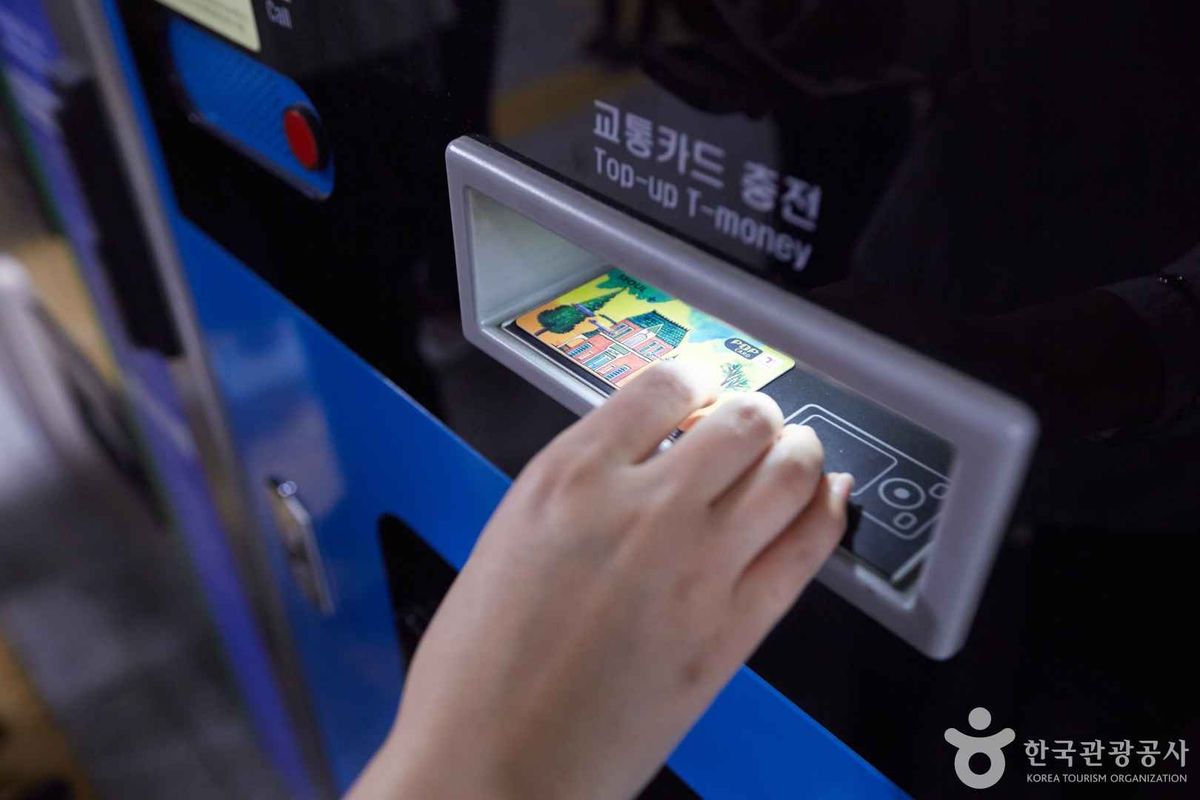
- Pay in Korean won cash at convenience stores or the top-up machines in subway stations.
- Top-ups go in ₩1,000 units, from ₩1,000 to ₩90,000 at a time.
- A card can hold up to ₩500,000.
- At a convenience store, hand over the card and cash and say how much you want to add.
Can I top up with a foreign credit card? For a plastic T-money card, plan on cash. (On an iPhone, see the Apple Wallet section below.) Since March 17, 2026, the Seoul government says 440 newer ticket machines at 273 stations on Lines 1–8 accept foreign Visa and Mastercard cards. Those machines sell single-journey tickets and Climate Card short-term passes. The city says it charges an average service fee of about 3.7%. The announcement doesn’t cover loading a normal T-money balance by foreign card, so don’t count on it.
Can I tap my credit card at the gate? No. As of October 2026 we found no official notice saying foreign contactless cards work at Seoul subway gates. You tap a transit card or ticket.
T-money on an iPhone (Apple Wallet)
Since March 2026, visitors with an iPhone can ride with T-money on the phone instead of a plastic card, as long as they set it up and top it up inside Tmoney’s own app. Here’s what Tmoney Co.’s App Store listing for the MobileTmoney app says (checked October 10, 2026):
- “Now available for international users.” The listing says no sign-up is needed, and that you tap your iPhone or Apple Watch at subway gates and on buses.
- Top-ups in the app go through Apple Pay with a card already in your Wallet. The listed networks are Mastercard, American Express and UnionPay (from the March 18, 2026 update), with JCB added on July 1, 2026.
- Visa isn’t on the list. If your only card is a Visa, use a plastic T-money card and top it up with cash.
- Phone requirements: iPhone XS / XR or later with iOS 17.2 or later, or Apple Watch Series 6 / SE (2nd generation) or later with watchOS 10.2 or later.
- Use the MobileTmoney app, not the Wallet app’s own “add transit card” option. Apple’s support page (published February 4, 2026) still says a South Korea-issued card is needed to buy or top up a Tmoney card from Apple Wallet itself.
- Your bank may add a foreign transaction fee. Check the amount on the Apple Pay sheet before you confirm.
Two things this doesn’t change: you still can’t tap a foreign credit card itself at the gate, and the official notes above cover iPhone only. We found no official notice about topping up Tmoney’s Android app with a foreign card, so Android users should plan on a plastic card.
What rides cost
Subway (Seoul, from June 28, 2025)
| Rider | With a transit card | Single-journey ticket |
|---|---|---|
| Adult (19–64) | ₩1,550 | ₩1,650 |
| Teen (13–18) | ₩900 | ₩1,650 |
| Child (6–12) | ₩550 | ₩550 |
- The base fare covers trips of up to 10 km. Longer trips add ₩100 for every extra 5 km.
- The city gives a 20% discount on the first card ride before 6:30 AM.
- Single-journey tickets carry a ₩500 deposit, which you get back from a deposit refund machine after your ride.
- Teen and child fares on a T-money card only apply if the card is registered with the rider’s date of birth. You can do that at a convenience store or a station information center, with ID.
Seoul city buses (card fares from August 12, 2023)
| Bus type (color) | Adult card fare |
|---|---|
| Trunk (blue) and branch (green) | ₩1,500 |
| Circulation (yellow) | ₩1,400 |
| Rapid / wide-area (red) | ₩3,000 |
| Late-night “owl” (N routes) | ₩2,500 |
| Local / village bus (green, smaller) | ₩1,200 |
The city’s table shows the same adult price for cash on these routes, but cash rides don’t earn transfer discounts (see below). A card is simpler and usually cheaper over a day.
Free transfers: how they work
Seoul links subway and bus fares so that one journey with changes is charged roughly as one trip:
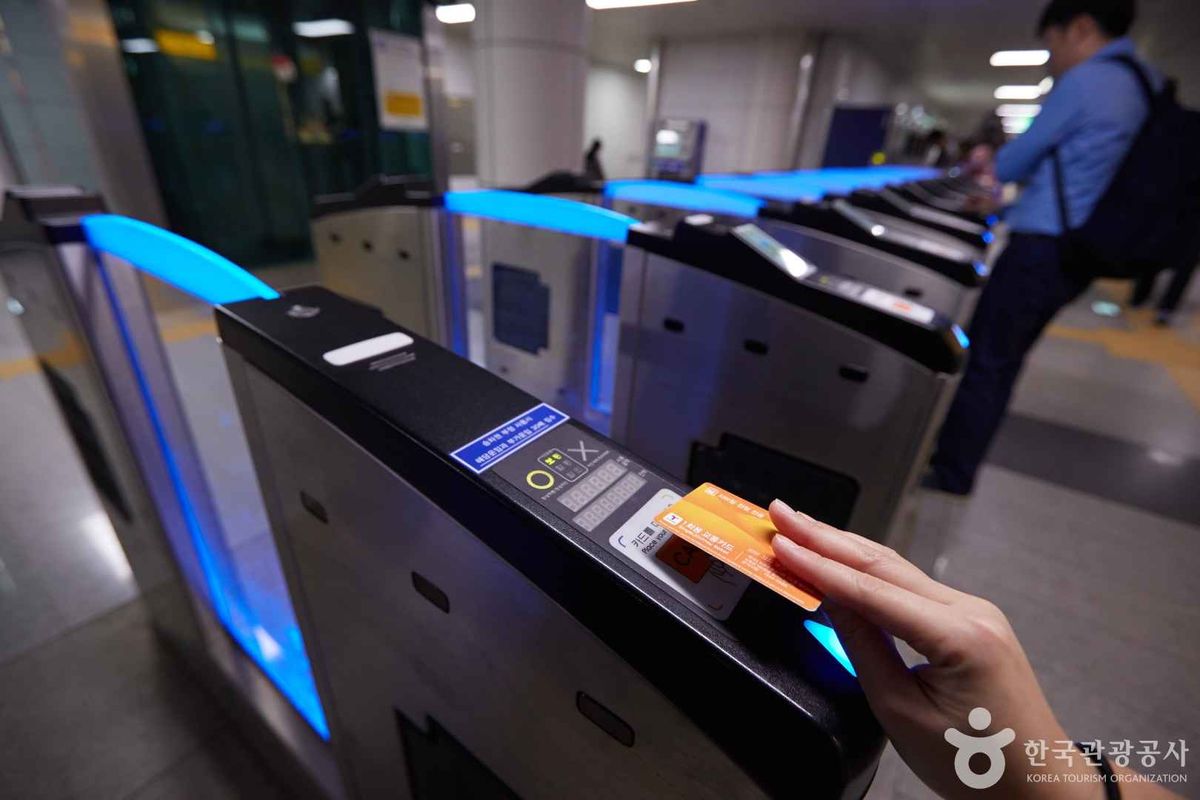
- Tap on and tap off every time, on the subway and on buses. On a bus, tap the reader at the rear door as you get off. If you skip it, the next ride is charged as a new trip.
- Change within 30 minutes of getting off. From 9 PM to 7 AM the window stretches to 60 minutes.
- Up to four transfers (five rides) count as one journey, according to the city’s bus page.
- The fare is based on the whole distance, starting from the highest base fare among the vehicles you used.
- Getting back on the same bus route doesn’t count as a transfer.
Paying cash or using a single-journey ticket breaks the link, which is another reason to use a card.
Climate Card short-term passes
The Climate Card (기후동행카드) is Seoul’s unlimited-ride pass. The 30-day version was discontinued on October 1, 2026 (the city’s FAQ gives September 29 as the last day of use for prepaid cards and September 30 for postpaid), but the city says the short-term passes continue:
| Pass | Price |
|---|---|
| 1 day | ₩5,000 |
| 2 days | ₩8,000 |
| 3 days | ₩10,000 |
| 5 days | ₩15,000 |
| 7 days | ₩20,000 |
Things to know before you buy:
- You need the physical card first. It costs ₩3,000 from the newer ticket machines in stations on Lines 1–8. You then load the pass onto it, in cash or with a foreign card at those machines.
- A 1-day pass is a calendar day, not 24 hours. The city’s example: charge it on July 1 and it ends after the last bus or train that night. Buy it in the morning, not at 9 PM.
- It’s for Seoul. The city lists the Sinbundang Line, intercity and airport buses, and subway trips that end outside the service area as not covered. If you leave the area, staff collect the fare.
- Tap on and off as usual. The city’s FAQ says the missed tap-off penalty doesn’t apply to short-term passes.
- Refunds: unused value minus a ₩500 fee, requested before the pass expires. Visitors without a Korean bank account are pointed to T-money’s headquarters.
Is it worth it? At ₩1,550 a ride, four subway rides cost ₩6,200, more than a ₩5,000 day pass. If you’ll take three or fewer rides a day, pay as you go.
Worked cost examples
All figures are adult card fares from the tables above. A ride means a subway trip of up to 10 km, and a transfer within the time limit counts as part of the same ride.
| Trip | What you pay | Why |
|---|---|---|
| One subway ride, up to 10 km | ₩1,550 by card | A single-journey ticket is ₩1,650, plus a ₩500 deposit you reclaim afterwards |
| One subway ride of 15 km | ₩1,650 | ₩1,550 base + ₩100 for 5 km over 10 km |
| One subway ride of 20 km | ₩1,750 | ₩1,550 base + ₩200 for 10 km over 10 km |
| Blue bus (5 km) then subway (10 km), transfer within 30 minutes | ₩1,650 | Whole distance 15 km, from the higher base fare (₩1,550) + ₩100. Without the transfer it would be ₩1,500 + ₩1,550 = ₩3,050, so the transfer saves ₩1,400 |
| 3 days, 4 subway rides a day, on T-money | ₩18,600 in fares | 12 rides × ₩1,550, plus the card (₩3,000–5,000) |
| 3 days, 4 subway rides a day, on a Climate Card | ₩13,000 | 3-day pass ₩10,000 + physical card ₩3,000 |
| Leaving Korea with ₩12,000 left on T-money | ₩11,500 back | Balance minus the ₩500 refund fee |
When does a Climate Card pass start to cost less? Counting only the base subway fare and leaving out the card, these are the break-even points:
| Pass | Price | Rides needed before it costs less |
|---|---|---|
| 1 day | ₩5,000 | 4 |
| 2 days | ₩8,000 | 6 |
| 3 days | ₩10,000 | 7 |
| 5 days | ₩15,000 | 10 |
| 7 days | ₩20,000 | 13 |
Compare by paid rides, not by vehicles. A bus and a subway on one transfer are charged as one ride on T-money. If you end a subway trip outside the Climate Card area, staff collect the fare for that whole trip. The city’s FAQ lists getting off at Incheon Airport Terminals 1 and 2 as covered since October 1, 2026.
Common mistakes and what they cost
| Mistake | What happens | How to avoid it |
|---|---|---|
| Forgetting to tap off a bus | The next ride is charged as a new trip, and you lose the transfer (₩1,400 in the example above) | Tap the reader at the rear door every time |
| Paying for several people with one card on a bus | The city says the subway transfer discount doesn’t apply to multi-passenger boarding | One card each |
| Buying a 1-day Climate Card at night | It ends after that night’s last train | Buy it in the morning |
| Taking a Climate Card outside its area | Staff collect the fare for that trip | Check the area before you go; use T-money for trips out of Seoul |
| Loading a lot of money on T-money near the end of the trip | ₩500 refund fee, and balances over ₩50,000 refund only at Tmoney Town near Seoul Station | Top up ₩10,000–20,000 at a time |
| Losing or damaging a single-journey ticket | The city says the ₩500 deposit can’t be refunded | Keep it safe and use a deposit refund machine after your ride |
Getting money back when you leave
T-money’s guide says you can get your balance back as cash at places that sell and top up cards, minus a ₩500 service fee. The card price itself isn’t refunded. Partial refunds (₩10,000 to ₩50,000, in ₩10,000 units, plate-type cards only) are available only at Tmoney Town and the Tmoney service centers in subway stations, according to T-money’s guide. VISITKOREA notes that balances over ₩50,000 can only be refunded at Tmoney Town near Seoul Station Exit 10, so don’t overload the card near the end of your trip.
Practical tips
- Keep ₩10,000–20,000 in cash for top-ups until you know which machines near you take cards.
- Give everyone their own card. The city notes that the subway transfer discount doesn’t apply to multi-passenger boarding, where one card pays for several people on a bus.
- Tap only one card. Hold the card itself to the reader until it beeps, rather than a wallet holding several cards.
- Help in English: the Seoul Dasan Call Center (120, then 9 for foreign languages, per T-money) or the 1330 Korea Travel Hotline. See our help and emergencies guide.
- Route planning: use a Korean map app for live transit times. Our Naver Map and KakaoMap guide shows how.
FAQ
Can I pay for the Seoul subway with Apple Pay or a contactless credit card?
You can’t tap a foreign credit card at the gate. On an iPhone, though, you can set up T-money in Tmoney’s MobileTmoney app and top it up there with Apple Pay using a Mastercard, American Express, UnionPay or JCB card (not Visa). You then tap the iPhone or Apple Watch like a T-money card. Topping up from the Wallet app itself still needs a Korean-issued card, according to Apple. Newer ticket machines on Lines 1–8 also accept foreign cards for single tickets and Climate Card passes, with a service fee.
Do I need cash in Seoul?
A little. Plastic T-money top-ups are cash in won at convenience stores and many station machines. Carry some won for that, even if you pay for most other things by card.
Does T-money work outside Seoul?
T-money’s own visitor card covers buses, subways and taxis without limiting itself to Seoul. Rules vary between cities, so check locally when you travel further. The Climate Card is the one that’s Seoul-only.
Is a single-journey ticket a bad idea?
It works fine for one trip. It costs ₩100 more than a card fare, needs a ₩500 deposit you have to reclaim, and doesn’t give you transfer discounts. If you’ll ride more than once or twice, buy a card.
This is an unofficial guide. We’re not affiliated with T-money, Seoul Metro, the Seoul Metropolitan Government or any card provider. Always check official notices for current fares.