Last checked: 2026-10-27 (ski dates, indoor options and the flight-disruption section: 2026-11-09). Temperatures are the Korea Meteorological Administration’s (KMA) 1991–2020 climate normals. Warning rules come from KMA’s own criteria page. Ski resort and event details are from the 2025–26 season, because we had not found the 2026–27 schedules when we last looked on November 9, 2026. Confirm any date with the operator.
Korean winters are cold and dry, with bright skies and real cold. The coldest mornings in the capital are well below freezing, while the south coast and Jeju stay noticeably milder. If you pack for the right place and know what the official weather warnings mean, winter is a good time to visit: palaces are quieter, hot spas feel better, and the ski slopes are within a few hours of Seoul.
Quick answer
- What to pack for December to February: Seoul averages highs of 2.1–5.1°C and lows of -5.5 to -3.2°C, so bring a long padded coat, a thermal base layer, a hat, gloves and non-slip shoes. Busan and Jeju are milder; the table below goes month by month.
- If a cold wave warning is issued: swap outdoor plans for indoor ones. The National Museum of Korea’s permanent galleries are free and open until 21:00 on Wednesdays and Saturdays.
- If snow is forecast on your flight day: follow your airline’s notice, not the crowd. Keep a spare day before an international flight home, especially if you are coming back from Jeju.
- Ski opening dates for 2026–27: we had not found official dates as of November 9, 2026. In 2025–26 the first resorts opened on November 21 and the rest by mid-December.
How cold does it get?
The table shows the average daily high and low in °C for each month. A typical afternoon is near the high and a typical early morning near the low. These are 30-year averages, so individual days can be much colder.
| Month | Seoul | Busan | Jeju City | Gangneung |
|---|---|---|---|---|
| Nov | 11.9 / 3.5 | 16.6 / 8.3 | 16.4 / 10.4 | 14.0 / 5.6 |
| Dec | 4.2 / -3.4 | 10.4 / 2.0 | 11.0 / 5.6 | 7.7 / -0.5 |
| Jan | 2.1 / -5.5 | 8.2 / -0.1 | 8.6 / 3.7 | 5.3 / -2.7 |
| Feb | 5.1 / -3.2 | 10.2 / 1.5 | 9.9 / 4.0 | 7.1 / -1.3 |
| Mar | 11.0 / 1.9 | 13.8 / 5.3 | 13.3 / 6.6 | 11.7 / 2.6 |
Source: KMA climate normals 1991–2020, stations Seoul (108), Busan (159), Jeju (184) and Gangneung (105), as shown in our weather by month tool. The tool also gives rainfall, humidity and sunshine, and a packing list.
Two things stand out. January is the coldest month in every city. And Seoul’s average January low of -5.5°C is 5.4°C below Busan’s (-0.1°C) and 9.2°C below Jeju City’s (3.7°C). If you hate the cold, the south coast and Jeju are the milder choices for a short winter trip.
What the official cold wave warning means
KMA issues cold wave warnings only between October and April. There are two levels, and each has two ways to trigger.
| Level | Trigger A (sudden drop) | Trigger B (lasting cold) |
|---|---|---|
| Advisory | Morning low falls 10°C or more from the day before, to 3°C or below, and is at least 3°C below normal | Morning low of -12°C or below expected for 2 or more days |
| Warning | Morning low falls 15°C or more from the day before, to 3°C or below, and is at least 3°C below normal | Morning low of -15°C or below expected for 2 or more days |
Compare that with the Seoul average January low of -5.5°C: an advisory for lasting cold means mornings roughly 6.5°C colder than that average for at least two days. The “sudden drop” trigger matters for visitors because it can apply before it is extremely cold: it needs only a morning low of 3°C or below that is both 10°C lower than the day before and at least 3°C below normal for the date.
KMA also lists these warnings that matter in winter:
- Heavy snow: advisory when 5 cm or more of snow is expected within 24 hours, warning at 20 cm or more (30 cm or more in mountain areas).
- Strong wind (inland): advisory at an average wind of 14 m/s or gusts of 20 m/s; warning at 21 m/s average or 26 m/s gusts.
Heavy snow and strong wind can disrupt road, air and sea travel. We could not find an official statement of when airlines or ferries cancel, so check your carrier’s own notice.
Staying safe in the cold
KMA’s public guidelines for cold waves, which it summarises from the Ministry of the Interior and Safety, include:
- General advice, not taken from the KMA guideline: keep outdoor activity short, cover exposed skin, and stay warm, hydrated and fed.
- Know the signs of hypothermia (severe chills, memory loss, slurred speech) and get medical help straight away. In Korea call 119 for medical emergencies.
- For frostbite, don’t rub the area or put it near direct heat. Rinse with warm water, keep it covered and go to a hospital.
- On icy roads, shorten your stride by 10–20% and wear low-heeled, non-slip shoes.
Ice is the most common winter problem for travelers. Sidewalks near hills, bus stops and the steps of stations can be slick after snow or freezing rain. Choose shoes with a grip, and take a taxi (see our taxi guide) rather than walking steep streets at night.
What to wear and pack
There is no official clothing chart. Our rule of thumb, which is also built into the weather tool, matches the numbers above:
| Where and when | Average high / low (°C) | What to pack |
|---|---|---|
| Seoul, December | 4.2 / -3.4 | Long padded or down coat, thermal base layer, sweater, hat, scarf, gloves, shoes with traction |
| Seoul, January | 2.1 / -5.5 | The same, plus a second thermal layer for early mornings and night markets |
| Seoul, February | 5.1 / -3.2 | The same as December |
| Gangneung, December to February | 5.3–7.7 / -2.7 to -0.5 | Padded coat, sweater, hat and gloves |
| Busan, December to February | 8.2–10.4 / -0.1 to 2.0 | Warm jacket or light padded coat with a sweater |
| Jeju City, December to February | 8.6–11.0 / 3.7–5.6 | Warm jacket and a windproof layer, because wind can make it feel colder |
These are 30-year averages from the table above, so a cold wave can sit well below them. Ski resorts are in the mountains and colder than these cities.
Indoors: subways, cafés and shops are usually heated, so layers you can take off are more useful than one very thick coat.
Dress one step warmer if you feel the cold easily, or if you are going to a late concert or night market where you will be standing outside.
If a cold wave hits: indoor plans
KMA’s cold wave warnings are based on the morning low. Our own suggestion is to keep any outdoor stop for the early afternoon, because early mornings and evenings are the coldest part of the day, and fill the rest of the day indoors. These are the options we could confirm:
- National Museum of Korea, Seoul. The permanent galleries are free. Hours are 09:30–17:30, and 09:30–21:00 on Wednesdays and Saturdays, with last entry 30 minutes before closing. The museum’s 2026 list shows it closed on January 1, Seollal day and Chuseok day. The permanent galleries also close on the first Monday of March, June, September and December, including December 7, 2026. Check the 2027 dates on its site.
- Lotte World Indoor Ice Rink, Seoul. VISITKOREA says it “can be enjoyed regardless of the weather”. The hours it listed in December 2025 were 11:00–20:50 Sunday to Thursday and 11:00–21:20 on Friday and Saturday.
- Underground shopping areas, Seoul. A 2018 city guide names Hoehyeon, Jamsil, Euljiro, Gangnam and Gangnam Terminal. Shops and zones may have changed since then.
- Jjimjilbang and hot baths. See our jjimjilbang guide.
- Ski resorts for non-skiers. VISITKOREA says most have a waterpark, sauna or café, so check the resort if someone in your group won’t ski.
Snow and flight delays
We found no official rule for when a flight is cancelled, but two recent cases show the range. Both sets of figures come from Korean press reports.
- Incheon, November 27, 2024. According to Incheon Airport Corporation, as of 09:00, 37 of 1,219 scheduled flights were cancelled and 162 delayed (the report’s headline says 34 cancellations). The corporation attributed 1 cancellation and 10 delays directly to the snow, and the other 36 cancellations were made in advance by airlines.
- Jeju, February 8, 2026. Strong wind and heavy snow hit together and the runway closed for part of the morning. By early afternoon, 164 domestic flights had been cancelled, out of 461 scheduled flights in total, and about 11,000 passengers were stranded.
What to do if snow or strong wind is forecast (our own advice):
- Turn on your airline’s app notifications and check the flight status on the airline’s site or on Incheon Airport’s site (airport.kr) before you leave for the airport.
- Don’t cancel yourself. Seoul Shinmun reported that at Jeju in February 2026 passengers were told that only those on cancelled flights would get text notices, and to keep their bookings.
- Allow a spare day before an international flight home, above all if you are coming back from Jeju. Delays there can cascade onto the next flight.
- Don’t plan a concert or a same-day connection for the day you land.
On compensation, Korea’s Consumer Dispute Settlement Standards (a Fair Trade Commission notice) set compensation for delayed flights, but in the wording quoted by the Korea Consumer Agency for international flights they exclude delays caused by weather, airport conditions and similar unavoidable reasons. Since a revision on February 28, 2018, an airline has had to be able to prove the unavoidable cause to be exempt. These standards are a basis for resolving disputes, so don’t count on a payment at the airport. Keep your boarding pass and the airline’s delay notice.
Air quality in winter
December to March is when fine dust (PM2.5) is most likely to be a problem in Seoul, and the city runs seasonal emission controls then. For the 2025–26 winter the Seoul government ran its 7th seasonal fine dust management program (December 2025 to March 2026), with restrictions on the highest-emission vehicles and road cleaning among other measures. We did not find the 2026–27 dates.
AirKorea’s 24-hour PM2.5 grades are: good 0–15 µg/m³, moderate 16–35, bad 36–75 and very bad 76 or more. On bad days, many people wear a KF94 mask and keep outdoor time short. Most Korean map and weather apps show the grade, and AirKorea publishes it too.
Ski resorts within reach of Seoul
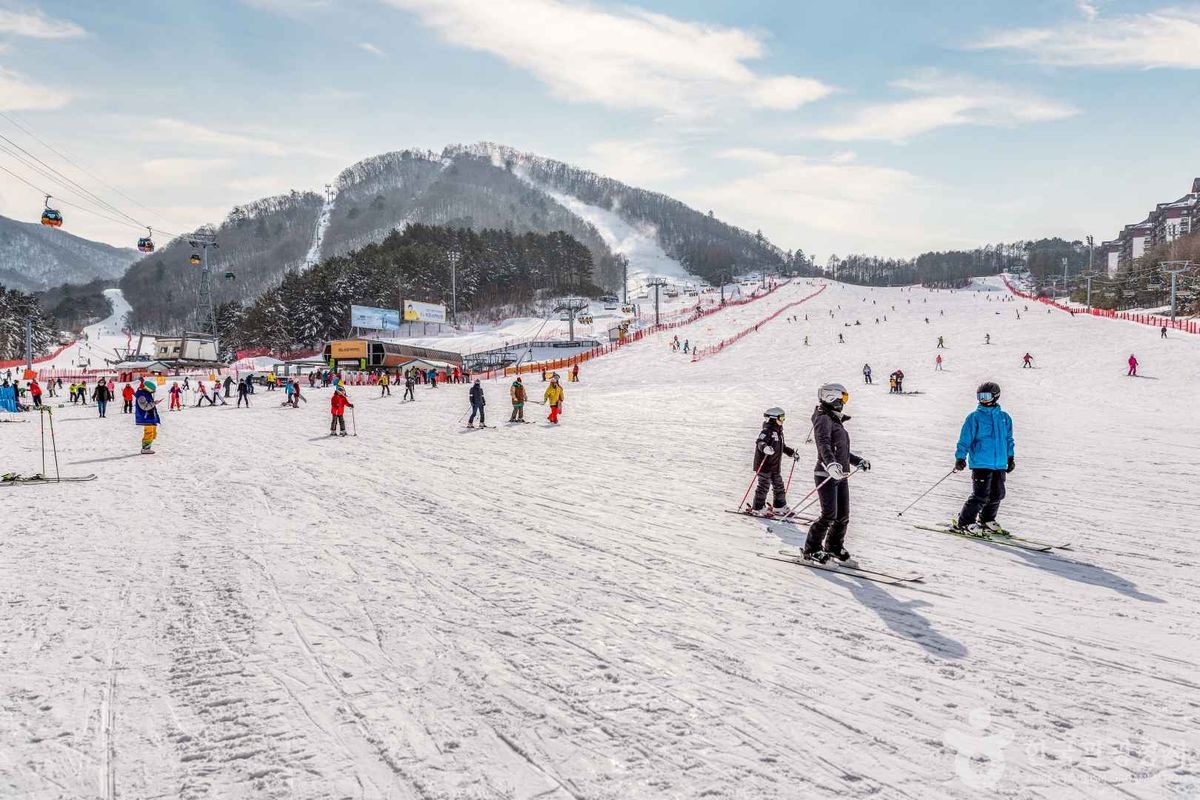
VISITKOREA’s winter ski guide, published in November 2025, lists 12 resorts. It says the season start and end at all resorts “are subject to change based on weather conditions.” These 2025–26 season start dates give you a rough idea of timing. As of November 9, 2026, we had not found official 2026–27 opening dates on VISITKOREA or on the pages we could read at High1, Mona Yongpyong and Alpensia, so don’t book a ski day around them yet.
| Resort | Area | 2025–26 season start | Access as listed by VISITKOREA |
|---|---|---|---|
| Mona Yongpyong | Pyeongchang | Nov 21, 2025 | Free shuttle from Jinbu Station (KTX) at 11:00 and 14:30 |
| Phoenix Snow Park | Pyeongchang | Nov 21, 2025 | No directions given on the page |
| High1 | Jeongseon | Nov 28, 2025 | Free shuttle from Gohan Station or Sabuk Station |
| Alpensia | Pyeongchang | Dec 4, 2025 | Free shuttle from Jinbu Station (KTX) at 11:00 and 15:00 |
| Elysian Gangchon | Chuncheon | Dec 5, 2025 | Gyeongchun Line from Yongsan to Baegyangni (about 1 hour), then a free shuttle |
| Vivaldi Park | Hongcheon | Dec 5, 2025 | Intercity bus from Chuncheon bus terminal, 7 departures a day |
| Konjiam Resort | Gwangju, Gyeonggi-do | Dec 10, 2025 | Taxi, about 10 minutes from Gonjiam Station (Gyeonggang Line) |
| Jisan Forest | Icheon | Dec 12, 2025 | Bus 12 from Icheon intercity bus terminal |
Tips from the same guide: reserve lodging and shuttles early for December to February; most resorts have a waterpark, sauna or café for non-skiers; many offer night skiing; and O2 Resort is high and cold, so dress warmly. The guide gives rental and lesson details for only a couple of resorts, so read each resort’s own website.
Several resorts run free shuttles from train stations, so you don’t need a car. Our KTX and SRT guide explains how to book trains.
Other winter things to do
- Ice skating: Seoul Plaza’s outdoor rink ran from December 19, 2025 to February 8, 2026 at ₩1,000 per session, by reservation. The Lotte World indoor rink is open all year. Dates and prices for the 2026–27 season were not confirmed.
- Festivals: the Hwacheon Sancheoneo Ice Festival ran January 10 to February 1, 2026, and the Pyeongchang Trout Festival was scheduled for January 2026, with dates depending on weather. Check the festival websites for 2027.
- Hot baths: a Korean jjimjilbang is the classic cold-weather break. See our jjimjilbang guide.
- Seollal: in 2027 the Lunar New Year holiday is February 6–9, so trains and some shops are affected. Read our Seollal 2027 guide.
FAQ
What is the coldest month in Korea?
January, according to KMA’s 1991–2020 normals. The average low is -5.5°C in Seoul and -2.7°C in Gangneung. Busan averages -0.1°C and Jeju City 3.7°C.
What is a cold wave advisory in Korea?
It is an official KMA alert for the period October to April. It is issued when the morning low is expected to drop 10°C or more from the day before to 3°C or below (and 3°C below normal), or when a morning low of -12°C or below is expected for two or more days. A warning is the stronger alert, with 15°C and -15°C as the thresholds.
Does it snow a lot in Seoul?
We don’t give a snowfall average because the monthly normals we use list rainfall and not snowfall. KMA issues a heavy snow advisory when 5 cm or more is expected in 24 hours, so a warning is a clear sign to expect disruption.
When does the ski season start?
In 2025–26, VISITKOREA lists openings from November 21 (Mona Yongpyong and Phoenix Snow Park) to mid-December. As of November 9, 2026, we had not found official 2026–27 dates. Start dates move with snow conditions, so check the resort site.
What should I do if it snows on my flight day?
Check your airline’s app and site before leaving for the airport, and don’t give up your booking until the airline confirms a change. Heavy snow can cancel or delay flights, and airlines may cancel some in advance. Allow a spare day before an international flight home.
What can I do indoors during a cold wave in Seoul?
The National Museum of Korea’s permanent galleries are free, and open until 21:00 on Wednesdays and Saturdays. Lotte World’s indoor ice rink and the jjimjilbang (Korean spas) are other weather-proof options. Check closed days before you go.
Is Busan a better winter choice than Seoul?
If you want milder weather, yes. The January average high is 8.2°C in Busan against 2.1°C in Seoul. Busan still has cold, windy days, so bring a proper coat.
What we could not confirm
- 2026–27 ski season dates, shuttle schedules and prices. The data above is the 2025–26 season. As of November 9, 2026, we had not found official 2026–27 opening dates. We could not read every resort’s site.
- Snowfall averages by city. The KMA normals file we used does not include them.
- When airlines and ferries cancel for snow or wind. We found no official rule. The Incheon and Jeju figures above come from press reports citing officials.
- The current full text of the flight compensation standards. We read the Korea Consumer Agency’s quotation (for international flights, from a decision around 2014) and the Fair Trade Commission’s 2018 release, not the latest notice.
- The 2026–27 Seoul skating rink and winter festival dates.
- Any official clothing recommendation. The clothing advice above is our own rule of thumb.
This is an unofficial guide. In an emergency call 119 (medical) or 112 (police), and call 1330 for travel help in English and several other languages.