What comes out of a Korean paycheck
Every month, Korean employers withhold six items from your pay before it reaches your account. The calculator above shows each one:
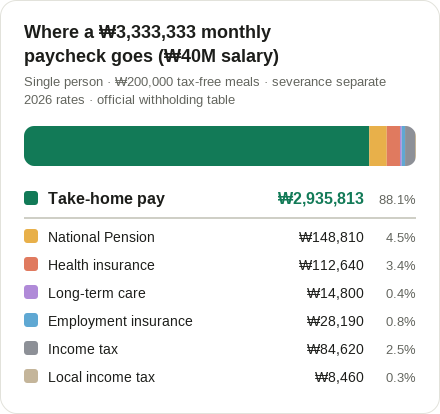
| Deduction | Your share in 2026 | Notes |
|---|---|---|
| National Pension (국민연금) | 4.75% | Applied to monthly income between a floor and a cap |
| Health insurance (건강보험) | 3.595% | Half of the 7.19% rate; the employer pays the other half |
| Long-term care insurance (장기요양보험) | 0.9448% of pay, shared with the employer | Funds elderly care |
| Employment insurance (고용보험) | 0.9% | Funds unemployment benefits |
| Income tax (근로소득세) | From the official withholding table | Depends on pay and dependents |
| Local income tax (지방소득세) | 10% of income tax |
Insurance is based on your pay excluding tax-free allowances such as a meal allowance of up to ₩200,000 a month. Income tax is taken from the National Tax Service’s simplified withholding table, and the real tax for the year is settled the following February in the year-end tax settlement (연말정산), when you either get a refund or pay a little more.
Annual salary, severance and the “÷ 13” question
Korean job offers state an annual salary (연봉). Normally it is divided by 12. Some contracts say severance is included in the annual salary; then the salary is divided by 13, and the 13th part is what you receive as severance when you leave. Ask which applies before you compare offers. Use the “Severance pay” option above to switch.
Rules that differ for foreign employees
Most payroll rules are the same regardless of nationality, but four items can change your take-home pay. Open Options for foreign employees in the calculator to apply them.
Flat 19% income tax
Under Article 18-2 of the Restriction of Special Taxation Act, a foreign employee (not a day laborer) may choose to pay income tax at a flat 19% instead of the normal progressive rates. Conditions under current law:
- you started working in Korea for the first time on or before December 31, 2026,
- it applies to pay received within 20 years of your first day of work in Korea,
- it does not apply if you work for a company with a special relationship to you, as defined in the law.
With the flat rate, no tax-free items, deductions or credits apply, so 19% is charged on your whole pay, plus local income tax of 1.9% (20.9% in total). You can ask your employer to withhold at 19% each month, or choose it at year-end settlement. It only pays off at high salaries: by this calculator’s withholding estimate, a single person comes out ahead at around ₩150 million a year, and the point is higher if you have dependents. Compare both in the calculator. The government’s 2026 tax reform proposal would raise the rate to 21% for income from 2027. It was still before the National Assembly when we last checked, and we will update this page if it passes.
National Pension depends on your nationality and visa
Foreign employees are generally covered by National Pension, but there are exceptions:
- By nationality: if your home country does not cover Koreans in a comparable pension system, you are excluded. The National Pension Service publishes the official list (136 countries as of March 19, 2026). Nationals of Nepal, Myanmar, Bangladesh, Pakistan, Kazakhstan, Singapore and Saudi Arabia, among others, are excluded at workplaces. Social security agreements with some countries can also exempt you if you submit a certificate from your home system.
- By visa: some statuses are excluded, including A-1 to A-3, B-1 and B-2, C-1, C-3 and C-4, D-1 to D-4, D-6, F-1, F-3 and G-1.
Lump-sum refund when you leave: E-9, H-2 and E-8 (training employment) holders, and nationals of countries with a refund agreement or equivalent rules, can claim back their contributions, including the employer’s share plus interest, after leaving Korea. E-8 seasonal workers are not eligible.
Long-term care insurance opt-out
Employees on E-9, H-2, D-3 or E-8 visas can apply to be excluded from long-term care insurance. If you have done so, tick the option and that line becomes ₩0.
Employment insurance depends on your visa
- F-2, F-5, F-6: covered, like Korean employees.
- D-7, D-8, D-9: covered if your home country covers Koreans in return.
- E-9, H-2: covered for job-security programs, but the unemployment benefit part, which is your 0.9%, applies only if you apply for it.
- C-4, E-1 to E-8, E-10, F-4, H-1: covered only if you apply.
Health and accident insurance are the same
If you are employed at a covered workplace and have registered as a foreign resident, you join workplace health insurance from your first month. The six-month waiting rule you may have heard about applies only to people who are not employees. Industrial accident insurance covers every worker regardless of visa status, and the employer pays all of it.
Frequently asked questions
Should I choose the 19% flat rate?
For most people, no. Normal progressive rates with deductions produce less tax than a flat 19% on everything until your salary is quite high (around ₩150 million a year for a single person in this calculator’s estimate). Tick and untick the option to compare with your own numbers. Your final tax is settled at year-end, so ask your employer’s payroll team or the National Tax Service before you commit.
Why is my payslip slightly different?
Payroll uses your exact insurance base (often last year’s reported pay), the table bracket for your income, any tax-free allowances, and sometimes housing or meal deductions agreed in your contract. Treat this result as an estimate.
Is my data saved?
No. The calculation runs in your browser and nothing you enter is sent or stored.