What is severance pay in Korea?
Korean law requires employers to pay a retirement benefit when an employee leaves. Under the Employee Retirement Benefit Security Act, every employer must set up a severance pay plan or a retirement pension plan, and if it sets up neither, the severance pay plan applies automatically. Severance pay (toejikgeum, 퇴직금) must be at least 30 days of average wages for each year of continuous service.
It applies to full-time, contract and part-time workers alike, and to workplaces of any size, including those with fewer than five employees. The Labor Standards Act also forbids discrimination based on nationality, so the rules are the same for foreign employees.
This calculator follows the Ministry of Employment and Labor’s method for the daily average wage and severance amount, then deducts retirement income tax and local income tax so you can see what you actually receive.
Who is eligible
You need both:
- One year or more of continuous service with the same employer.
- 15 or more contracted hours per week on average over four weeks.
Whether you reached one year is judged by your retirement date, which is the day after your last working day. If you started on October 1, 2025 and worked until September 30, 2026, your retirement date is October 1, 2026, so you have exactly one year. If your last day was September 29, you fall one day short and statutory severance does not apply.
How it is calculated
Step 1: daily average wage
Average wage is the total wages paid in the three months before your retirement date, divided by the number of days in that period (Labor Standards Act, Art. 2).
- Three months of pay: base pay plus allowances, before tax.
- Bonuses: bonuses paid in the year before you leave × 3/12.
- Annual leave pay: payment for unused annual leave × 3/12.
- Number of days: 89 to 92, depending on the months. If your last day is September 30, the period is July 1 to September 30 (92 days).
If this average is lower than your daily ordinary wage, the ordinary wage is used instead.
Step 2: severance formula
Severance = daily average wage × 30 days × (days employed ÷ 365)
Example: 3 years at ₩3 million a month
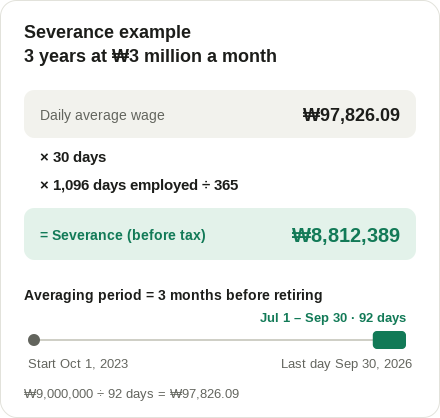
Started October 1, 2023, last day September 30, 2026, ₩3,000,000 a month before tax, no bonuses:
| Step | Calculation | Result |
|---|---|---|
| Days employed | Oct 1, 2023 – Sep 30, 2026 (includes leap year 2024) | 1,096 days |
| Averaging period | Jul 1 – Sep 30, 2026 | 92 days |
| Three months of pay | ₩3,000,000 × 3 | ₩9,000,000 |
| Daily average wage | 9,000,000 ÷ 92 | ₩97,826.09 |
| Severance | 97,826.09 × 30 × 1,096 ÷ 365 | ₩8,812,389 |
| Retirement income tax | see below | ₩91,490 |
| Local income tax | 10% of the above | ₩9,140 |
| After tax | ₩8,711,759 |
Tax on severance pay
Severance is taxed separately as retirement income, not as salary. To keep the tax low for long service, the amount is converted to a yearly figure, taxed at the basic rates, then multiplied back by the years of service (Income Tax Act, Art. 48 and 55).
- Years of service: any part of a year counts as a full year (3 years 2 months = 4 years).
- Service-years deduction: ₩1 million per year for up to 5 years, then larger amounts for longer service.
- Converted pay = (severance − service-years deduction) × 12 ÷ years of service.
- Converted pay deduction: all of it up to ₩8 million, then a sliding percentage.
- Tax base = converted pay − deduction, taxed at the basic income tax rates (6–45%).
- Retirement income tax = that tax ÷ 12 × years of service. Local income tax adds 10%.
The step-by-step table in the calculator shows each of these numbers for your case.
For foreign employees
The severance formula is the same for every nationality. A few points matter specifically for foreign workers:
- E-9 and H-2 workers: departure guarantee insurance. Employers of workers under the Employment Permit System must take out departure guarantee insurance (출국만기보험) to fund severance, and paying into it counts as the company’s severance plan. The insurer pays you within 14 days after you leave Korea. If the payout is less than your legal severance, the employer must pay the difference. If you worked less than one year, there is no severance and the insurance money goes back to the employer.
- Leaving Korea: cash instead of an IRP. Severance is normally transferred to an IRP account, but if you worked on a work visa (C-4, E-1 to E-10 or H-2) and leave Korea after retiring, it can be paid directly.
- The 19% flat rate does not apply to severance. That special rate covers salary only. Severance is taxed as retirement income with the normal calculation above.
Frequently asked questions
I worked 11 months. Do I get anything?
Not under the law. Statutory severance requires at least one year of continuous service. Your employment contract or company rules may still promise severance for shorter service, in which case that promise applies.
When must my employer pay it?
Within 14 days of your retirement date, unless special circumstances apply and you both agree to a later date (the law doesn’t require that agreement to be in writing, but get it in writing anyway). Late payment can carry interest, and the right to claim severance expires after three years.
Why is it paid into an IRP account?
As a rule, severance is transferred to an individual retirement pension (IRP) account that you designate, with exceptions set by law such as retiring at 55 or older. If it goes into a pension account, the retirement income tax is not withheld until you take the money out other than as a pension. The after-tax figure in this calculator assumes the tax is withheld when you receive cash.
What if I took parental leave or sick leave recently?
Periods such as parental leave, maternity leave, injury leave or the first three months of probation are excluded from the three-month averaging period. This calculator does not handle those exclusions, so use the Ministry of Employment and Labor’s official calculator if they apply to you.
Is my data saved?
No. The calculation runs in your browser and nothing you enter is sent or stored.