What is weekly holiday pay?
In Korea, an employee who works every scheduled day in a week earns one paid day off per week. The pay for that day is called juhyu sudang (주휴수당), usually translated as weekly holiday pay or weekly holiday allowance. It comes from Article 55 of the Labor Standards Act, which requires employers to give at least one paid holiday a week on average.
It is not only for full-time staff. Part-timers at convenience stores, cafés and restaurants get it too, as long as they meet the two conditions below. For hourly workers it is a big difference: at 20 hours a week it adds about ₩180,000 a month.
This calculator checks whether you qualify, then shows your weekly pay, estimated monthly pay and the take-home amount if 3.3% is withheld.
Who qualifies
You need both of these:
- 15 or more contracted hours per week. “Contracted” means the hours agreed in your employment contract, not the hours you happened to work. If your hours change from week to week, the average over four weeks is used (Labor Standards Act, Art. 18(3)).
- Full attendance on your scheduled days that week. If you miss a scheduled workday, you lose that week’s holiday pay (Enforcement Decree, Art. 30). It comes back the next week you attend every scheduled day.
The Labor Standards Act also bans discrimination based on nationality (Art. 6), so these rules are the same for Korean and foreign workers.
Exception: farming, livestock and fishing. Article 63 of the Labor Standards Act excludes workers in agriculture, livestock raising, sericulture and fisheries from the rules on working hours, breaks and holidays, so weekly holiday pay does not apply to them. This applies to everyone in those sectors, Korean or foreign, and it affects many E-9 workers.
How it is calculated
Holiday pay equals one “average day” of your contracted hours:
Weekly holiday pay = (weekly contracted hours ÷ 40) × 8 × hourly wage
The holiday is capped at 8 hours, even if you work more than 40 hours a week, because hours above 40 count as overtime instead.
For monthly pay, the Minimum Wage Act’s conversion method is used: (weekly hours + holiday hours) × 365 ÷ 7 ÷ 12, which is about 4.345 weeks per month, multiplied by your hourly wage.
Example: 4 hours a day, 5 days a week
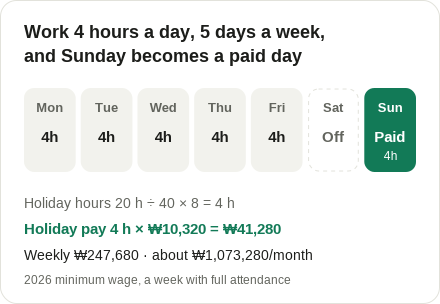
- Holiday hours: 20 ÷ 40 × 8 = 4 hours
- Holiday pay: 4 × ₩10,320 = ₩41,280 (2026) or 4 × ₩10,700 = ₩42,800 (2027)
- Weekly pay: 20 × ₩10,320 + ₩41,280 = ₩247,680 (2026), or 20 × ₩10,700 + ₩42,800 = ₩256,800 (2027)
- Monthly paid hours: about 104 → monthly pay about ₩1,073,280 (2026) or ₩1,112,800 (2027)
At 40 hours a week, the same method gives 209 paid hours: ₩2,156,880 a month in 2026 and ₩2,236,300 in 2027. Both match the monthly minimum wage published by the Ministry of Employment and Labor for that year. In other words, the official monthly minimum already includes the weekly holiday.
The 2026 and 2027 minimum wage
The minimum wage applies from January 1 to December 31 each year, so two amounts are in use around the new year. The calculator lets you pick the year.
| 2026 | 2027 | |
|---|---|---|
| Hourly | ₩10,320 | ₩10,700 (up ₩380, 3.7%) |
| Daily (8 hours) | ₩82,560 | ₩85,600 |
| Monthly (209 hours) | ₩2,156,880 | ₩2,236,300 |
| Probation rate (90%) | ₩9,288 | ₩9,630 |
| Applies | Jan 1 to Dec 31, 2026 | Jan 1 to Dec 31, 2027 |
The 2027 rate was approved by the Minimum Wage Commission on July 14, 2026 and announced by the Ministry of Employment and Labor on August 5, 2026 (Notice No. 2026-60). The 2026 rate stays in force until December 31, 2026 and the 2027 rate takes over on January 1, 2027.
An employer may pay 90% of the minimum only during the first three months of probation and only on a contract of one year or longer, and never for jobs designated as simple labor. Any agreement to pay less than the minimum is void for the difference.
3.3% withholding vs social insurance
Some part-time jobs are paid as freelance (business) income, with 3% income tax plus 0.3% local income tax withheld. If you are registered as an employee instead, your share of National Pension, health insurance, long-term care and employment insurance is deducted, and income tax follows the official withholding table. The salary calculator handles that case once your wage is known.
Frequently asked questions
I work 14 hours a week. Do I get anything?
No. If your four-week average is under 15 contracted hours, the weekly holiday rule does not apply, and neither does annual paid leave. If your hours vary, calculate the four-week average before you decide.
Does a small shop with fewer than 5 employees have to pay it?
Yes. Workplaces with four or fewer regular employees are exempt from some parts of the Labor Standards Act, but the weekly paid holiday and the part-time worker rules still apply to them (Enforcement Decree, Table 1). Overtime and night-work premiums, on the other hand, apply only at workplaces with five or more employees.
What about my last week before I quit?
The Ministry of Employment and Labor changed its interpretation in 2021: if your employment continues through the whole week and you attend every scheduled day, you are owed that week’s holiday pay even if you will not work the following week. If your job ends before the week is over, you are not. When in doubt, ask the Ministry’s counseling center at 1350.
Is my data saved?
No. The calculation runs in your browser and nothing you enter is sent or stored.