Last checked: 2026-10-18. Station exits, opening hours and especially shops change quickly, and the official pages below were updated in different years. This guide organizes the areas rather than ranking individual shops or cafés, so it won’t tell you where to queue.
Seongsu, Hannam-dong and Yeonnam-dong are three Seoul neighborhoods that visitors increasingly add to a trip. None of them is a checklist of famous sights. You go to walk, to look into cafés, shops and galleries, and to see how a former factory district, a museum-and-showroom district and a railway-turned-park each feel on foot. All three are reachable by subway, and with a station, an exit and a walking order decided in advance you can cover one in half a day without wasting time.
The short version
| Area | What it’s good for | Easiest starting point (per official pages) |
|---|---|---|
| Seongsu (성수동) | Former factories turned into cafés, shops and pop-ups; a big park. Half a day to a full day | Line 2 Seongsu Station, Exit 3 or 4; Suin-Bundang Line Seoul Forest Station, Exit 3 or 4 |
| Hannam-dong (한남동) | Museums, galleries, brand showrooms and quiet residential streets. Half a day | Line 6 Hangangjin Station (Visit Seoul calls it the most convenient starting point) |
| Yeonnam-dong (연남동) | A walking path on an old rail line, with small streets and shops around it. Half a day | Hongik Univ. Station (Hongdae), Exit 3 for the park path |
- Pick two areas per day at most. Moving between all three eats the time you wanted to spend walking.
- Search for place names in Hangul. The table near the end lists the Korean names to paste into Naver Map or Kakao Map. Our map app guide explains how to use them.
- Check opening times just before you go. Shops and pop-ups change often, and many museums close on Mondays.
Seongsu (성수동)
What kind of area is it?
According to the Seoul city government, Seongsu-dong used to be lined with old factories and warehouses. From the 2010s, some of those buildings were reused for cultural and creative spaces, and the area became a place where design and culture gather. Visit Seoul describes streets that keep the factory-era look but now mix cafés, galleries, fashion shops and temporary pop-up stores. The company behind Olive Young said in November 2025 that Seongsu hosted an average of 14 beauty pop-ups per month, up from eight the previous year, citing a pop-up specialist. The practical effect is that places turn over fast: something you saw in an old blog post may be gone.
Getting there
- Line 2 Seongsu Station. The Seoul city page says Seongsu Yeonbang (성수연방), a cultural complex with bookshops, lifestyle shops and restaurants that combines the character of 1970s buildings with current trends, is about a two-minute walk from Exit 3. Visit Seoul’s distance listing for the same place is 337 m. The handmade shoe street is listed from Exit 4.
- Suin-Bundang Line Seoul Forest (서울숲) Station, Exits 3 and 4. Visit Seoul lists the park entrance about 242 m from here.
- Line 2 Ttukseom (뚝섬) Station. Visit Seoul lists Exit 8 about 537 m from the park.
Yeonmujang-gil (연무장길), sometimes called the Seongsu-dong café street, is a long road that runs from Ttukseom Station past Seongsu Station to the Seongsu crossroads, according to the Seoul city page. It is named after a Joseon-era drill ground. It is now known for cafés and handmade shoe workshops, and it is the spine for most walks here.
A half-day order to walk it
This follows the order of Visit Seoul’s one-day Seongsu course (published September 2026), adapted for a half day.
- Start at Seongsu Station and walk Yeonmujang-gil. Visit Seoul describes it as a street where former shoe-factory buildings sit among cafés, galleries, fashion shops and brand pop-ups.
- Look at the handmade shoe street (수제화거리). Visit Seoul says it is Korea’s largest handmade shoe production area, with about 70% of the country’s handmade shoe manufacturers. The Seoul city page gives about 350 manufacturers and 100 related processing and materials firms. Visit Seoul says made-to-order shoes take about one to two weeks, so on a short trip this is for looking, not buying, unless you can arrange delivery.
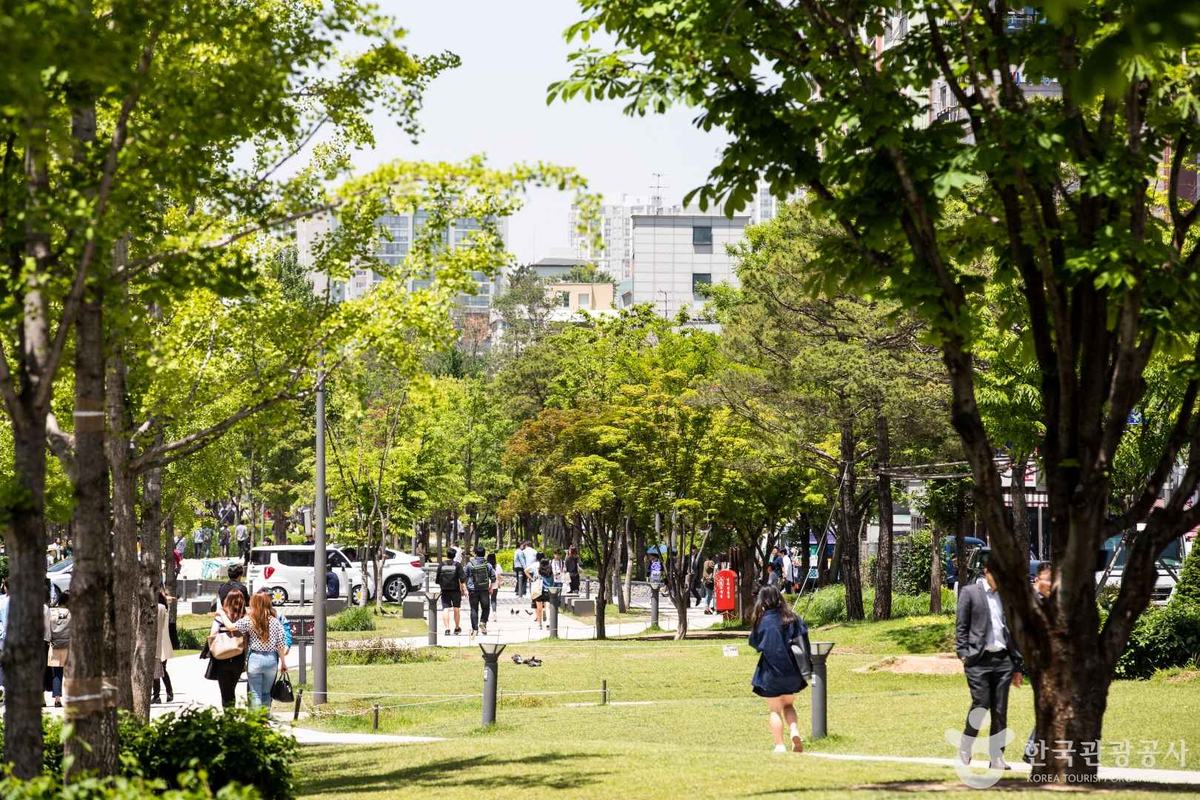
- Walk to Seoul Forest. The park is open 24 hours a day and is free. Some facilities have their own hours: the Insect and Plant Garden is 10:00 to 17:00 and closed on Mondays, and the Butterfly Garden is open May to October only, 10:00 to 17:00, also closed on Mondays (Visit Seoul).
- Finish at Seongsu Sky Bridge for a view of the Han River, Namsan Tower and the evening skyline. Visit Seoul advises arriving at least 30 minutes before sunset.
The Visit Seoul course also lists the Seongsu-dong galbi alley, an old outdoor dining lane with roots in the 1970s, and self-photo studios with themed booths. Some experiences such as makeup classes need a reservation, according to the same course page.
Hannam-dong (한남동)
What kind of area is it?
Hannam-dong is a quieter, upscale residential area next to Itaewon. Visit Seoul describes Hangangjin Station as lying between Itaewon and Noksapyeong stations, close to the Namsan walking trail, and lists the Hannam-dong showroom street, Leeum Museum of Art and nearby galleries as the draws. The sensible plan is to build the visit around one museum or gallery and then walk the streets.
Getting there
- Line 6 Hangangjin (한강진) Station. Visit Seoul’s arts tour calls it the most convenient starting point for Hannam-dong and Itaewon, without naming a single exit. Blue Square, a performance complex, is about 90 m from the station, and Pace Gallery Seoul is listed at about 210 m.
Walking order
- Leeum Museum of Art (리움미술관), 60-16 Itaewon-ro 55-gil, Yongsan-gu. Both Visit Seoul and VISITKOREA say it is closed on Mondays, and VISITKOREA adds New Year’s Day, Seollal and Chuseok. Beyond that the two official pages disagree: Visit Seoul (edited July 2026) says 10:00 to 18:00, Tuesday to Sunday, with the permanent exhibitions free; VISITKOREA gives 10:30 to 18:00 with last admission 30 minutes before closing, and lists a ₩10,000 adult ticket. We could not confirm which is current, so check Leeum’s own site before you go. Visit Seoul says free digital guides come in Korean, English, Chinese and Japanese.
- Streets around the museum. Walk the showroom street and the lanes of galleries. Many of these are commercial spaces with their own days and hours.
- Decide where to end. You can walk toward Itaewon or head back to the subway, depending on energy and time.
Visit Seoul’s Hannam-dong arts tour also includes a rooftop café and a hands-on workshop. The workshop is closed on Mondays and its sessions take about 90 minutes, which is another reminder that Monday is a weak day for this area.
Yeonnam-dong (연남동)
What kind of area is it?
The Seoul city government describes the Gyeongui Line Forest Park as a 1 km trail on the old railroad tracks, with trendy cafés and restaurants, boutiques and workshops along both sides, plus lawns and small ponds and streams. Its Yeonnam-dong section is nicknamed “Yeontral Park,” a blend of Yeonnam-dong and New York’s Central Park. A city page on the Gyeongui Line Book Street puts the whole walking route, including the forest path, at about 6.3 km, and describes the book street as a reading-themed regeneration space beside the Hongdae station complex.
Getting there
- Hongik Univ. (홍대입구) Station is an interchange for Line 2, the Gyeongui-Jungang Line and the Airport Railroad (AREX), so it is easy to reach from Incheon or Gimpo airports.
- Exit 3 leads to the forest park path, according to the Seoul city pages.
- Exit 6 is where a VISITKOREA course starts for the Book Street. We could only see that through a search summary of the page, not the page itself, so confirm the exit on a map.
Walking order
- Enter the forest path from Exit 3 and walk along it.
- Drop into the side streets for shops and cafés. These are residential streets, so keep your voice down.
- Decide on the way back: retrace your steps or find another station, depending on how much time you have.
Korean names to search or show
| Place | Hangul | Note |
|---|---|---|
| Seongsu Station | 성수역 | Line 2 |
| Seoul Forest Station | 서울숲역 | Suin-Bundang Line |
| Ttukseom Station | 뚝섬역 | Line 2 |
| Seongsu Yeonbang | 성수연방 | Address: 성수이로14길 14 |
| Yeonmujang-gil | 연무장길 | |
| Handmade shoe street | 수제화거리 | |
| Seoul Forest | 서울숲 | |
| Hangangjin Station | 한강진역 | Line 6 |
| Leeum Museum of Art | 리움미술관 | Address: 이태원로55길 60-16 |
| Hongik Univ. Station | 홍대입구역 | Line 2, Gyeongui-Jungang, AREX |
| Gyeongui Line Forest Park | 경의선숲길 | |
| Gyeongui Line Book Street | 경의선 책거리 |
Paste the Hangul into Naver Map or Kakao Map and the place appears reliably. If you take a taxi, show the screen to the driver; our taxi guide covers how to call one.
Combining the areas
- Seongsu Station and Hongik Univ. Station are both on Line 2, so you can ride between Seongsu and Yeonnam without changing trains. Don’t squeeze both into one day unless you plan to see each lightly.
- Hannam-dong is on Line 6, so check a route app for transfers from the other two.
- If you are in Seoul for a concert, Seongsu is also one of the neighborhoods fans pass through. See K-pop places to visit in Seoul for the etiquette that applies.
- For fares and passes, our T-money guide covers the subway.
Photo etiquette, queues and closed days
- These are residential neighborhoods. Seongsu, Hannam and Yeonnam sit right next to people’s homes. Keep your voice down, and don’t photograph doors or windows.
- Ask before photographing people. Avoid pictures with other customers or staff in them. Inside shops, follow signs and staff instructions. Some pop-ups and exhibitions restrict photography.
- Expect queues and reservations at popular pop-ups. Limited-time stores sometimes take reservations or cap numbers. Check the shop’s own announcement before you go.
- Mondays are a problem. Many museums and gardens close on Mondays, including Leeum and Seoul Forest’s Insect and Plant Garden. Individual shops set their own days, so check on the day.
- Exits can close for construction. Subway exits are sometimes closed temporarily. Check station notices or your map app on the day.
Frequently asked questions
Can I see both Seongsu and Yeonnam-dong in one day?
Both are on Line 2, so you can ride between them without changing trains. Seongsu alone often takes a half day or more, so a realistic plan is Seongsu in the morning and Yeonnam-dong in the afternoon, with each stop trimmed.
Which station is closest?
For Seongsu, Line 2 Seongsu Station (Exits 3 and 4) is easiest, and the Suin-Bundang Line’s Seoul Forest Station is closest to the park. For Hannam-dong it’s Line 6 Hangangjin, and for Yeonnam-dong, Hongik Univ. Station. Check exits on a map on the day.
Is Seoul Forest free?
According to Visit Seoul, entry to the park is free and it’s open 24 hours. Some facilities, such as the Insect and Plant Garden, Butterfly Garden and ground fountain, have their own hours and seasons.
Do I need reservations?
Not for the neighborhoods themselves. Museum programs, workshops, classes and popular pop-ups may require them. Visit Seoul’s Seongsu course says makeup classes need to be booked in advance.
Can I have shoes made during a trip?
Visit Seoul says custom shoes take about one to two weeks to make, which makes collecting them hard on a short stay. Ask the shop about pickup or delivery conditions.
What should I do if it rains?
Plan around indoor places: a museum in Hannam-dong, shops and pop-ups that are inside. The outdoor parks and forest paths are best on dry days.
This page is an unofficial guide based on public information. It is not affiliated with any shop or venue and doesn’t promote individual businesses. Hours, fees and closed days change, so check official sources before you visit.