Last checked: 2026-11-19. Fares, schedules and opening hours below come from the official pages listed in the sources, read on this date: Camellia Line’s fares and November to January sailing calendar, Humetro’s subway and light rail fares, VISITKOREA’s flight, airport, ferry and train pages, KORAIL’s notices and Visit Busan’s transport and sightseeing pages. Flights, ferries and trains change without notice, so confirm with the operator, with your travel dates entered, before you book.
Busan is Korea’s second-largest city, a port on the southeast coast about 2 hours and 17 minutes from Seoul by the fastest KTX. It is also the easiest big Korean city to reach from western Japan. Unlike Seoul, it is not one dense downtown. Beaches, markets, hillside neighborhoods and temples are spread along a long coastline, so the biggest decisions are where to sleep and how many areas to fit into your days. This guide covers how to arrive from Japan or Seoul, how to get from the airport into town, what getting around costs, how the main areas differ and how to plan two or three days, using official sources only.
The short version
- From Japan, flying is the standard way. VISITKOREA’s September 2026 route table lists daily direct flights to Gimhae Airport from Fukuoka (Air Busan, Eastar Jet, Jeju Air, Jin Air, Trinity Airways), Osaka/Kansai (the same five) and Tokyo/Narita (Korean Air, Air Busan, Jeju Air, Jin Air). Times and fares were not on that page, so check the airlines.
- The high-speed “Beetle” ferry is gone. JR Kyushu announced on December 23, 2024 that it was withdrawing from the Japan-Korea high-speed ferry business. The Hakata-Busan ferry we could confirm on an operator’s site in November 2026 is Camellia Line’s conventional ferry, about 6 hours by the timetable.
- From Gimhae Airport, light rail plus subway is the budget route. VISITKOREA gives about 30 minutes to Seomyeon, 50 to Gwangalli and 70 to Haeundae. Airport buses need a pre-bought ticket, and taxis take about 40 to 70 minutes.
- From Seoul, take the KTX. KORAIL lists 2 hours 17 minutes as the shortest KTX-Cheongryong time. Slower trains take longer.
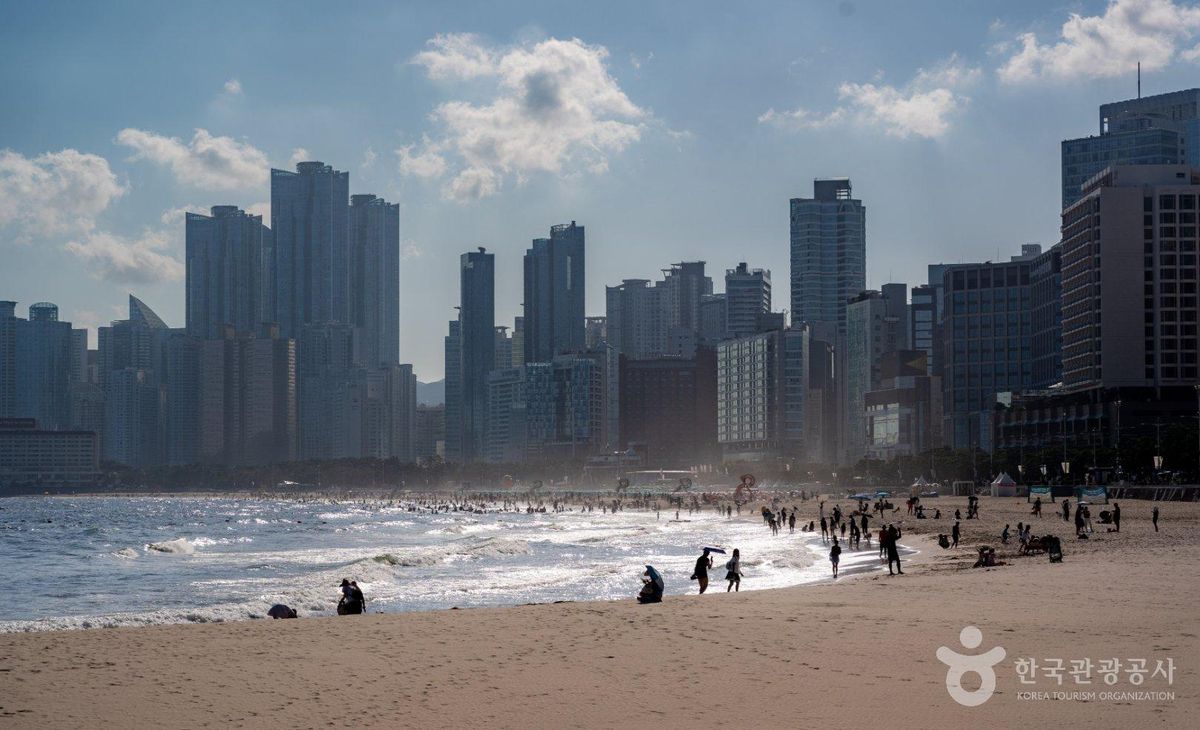
- Pick one side of the city for a short stay. Think of Haeundae and Gwangalli as the beach-and-night-view side, and Nampo-dong and Gamcheon as the old-town, market and hillside side. With one night, choose one side.
Busan versus Seoul: how a trip differs
| Point | Seoul | Busan |
|---|---|---|
| Main airports | Incheon and Gimpo | Gimhae, about 30 to 70 minutes from the main areas by public transport |
| Arriving from Japan by sea | No regular route that we could confirm | Ferries from Hakata, and routes listed by VISITKOREA from Shimonoseki, Osaka and Tsushima (status not confirmed) |
| Shape of the city | Dense, with subway lines everywhere | Sights spread along the coast and hills |
| Getting around | Subway reaches most places | Subway is the backbone, but expect walking or buses between a station and the sea |
| What most visitors come for | Shopping, cafés, palaces, K-pop | Beaches, markets, night views and hillside villages |
Some travelers combine Seoul and Busan on one trip, and that is workable, but remember that even the fastest KTX takes 2 hours 17 minutes each way. On a stay of two or three nights, one city leaves more of your time on the ground. If you are weighing it, our KTX and SRT guide explains booking.
Getting to Busan from Japan
This section is for readers starting in Japan. The same flight and ferry facts also help anyone planning a Korea-Japan trip from the Korean side.
| Option | Time | Cost and notes | Where to check |
|---|---|---|---|
| Flight, Fukuoka to Gimhae | Not stated on the official pages we read | Varies by airline. Five airlines are listed as flying daily | The airlines, Fukuoka and Gimhae airport sites |
| Ferry, Hakata to Busan | Timetable shows 12:30 departure and 18:30 arrival | From ¥15,000 for a second-class one-way adult ticket, plus charges | Camellia Line |
Flights
VISITKOREA’s page on Gimhae Airport (dated September 14, 2026) lists the daily direct routes noted above, and says schedules can change depending on airline and airport circumstances. We could not confirm flight times or fares from official sources, so use the airline sites or a fare search for your departure airport.
The Camellia Line ferry
Camellia Line’s published schedule for November 2026 to January 2027 shows these times:
| Direction | Check-in | Boarding complete | Departure | Arrival |
|---|---|---|---|---|
| Hakata to Busan | 10:30 to 11:30 | 12:10 | 12:30 | 18:30 |
| Busan to Hakata | 16:30 to 18:30 | 20:00 | 22:30 | 7:30 next morning |
- It does not sail every day. In November and December the calendar shows some Sundays with no departure from Hakata and some Saturdays with an extra late sailing from Hakata (boarding complete 20:00, departure 22:00, arriving Busan at 7:30), when there is no Busan departure. A day-by-day calendar is on the company’s site.
- Around New Year the pattern changes. There is no sailing from Hakata on December 29 and 30 or January 1, and none from Busan on December 28, 30 and 31. On December 31 an extra sailing leaves Hakata at 18:00, and passengers can get off in Busan from 8:30 the next morning. The January 2 extra sailing from Busan is only for customers on tours run by Japanese travel agencies. From January 3 the calendar shows sailings in both directions every day of the month.
- Adult one-way fares from October 1, 2026: ¥15,000 for second class, ¥17,000 for second-class sleeper, ¥21,000 for first class, and ¥28,000 for a special-class twin.
- Extra charges apply: a fuel surcharge (¥1,400 from Hakata, ₩14,000 from Busan), an international tourist tax (¥3,000 from Hakata), a terminal fee at Hakata (¥500 for adults), a port tax at Busan (₩6,000) and a tourism fund fee (₩1,000). Adding up the official figures, a second-class ticket from Hakata comes to ¥19,900 (our arithmetic).
- A Hakata departure leaves at midday and arrives in the evening, so your first day in Busan is short.
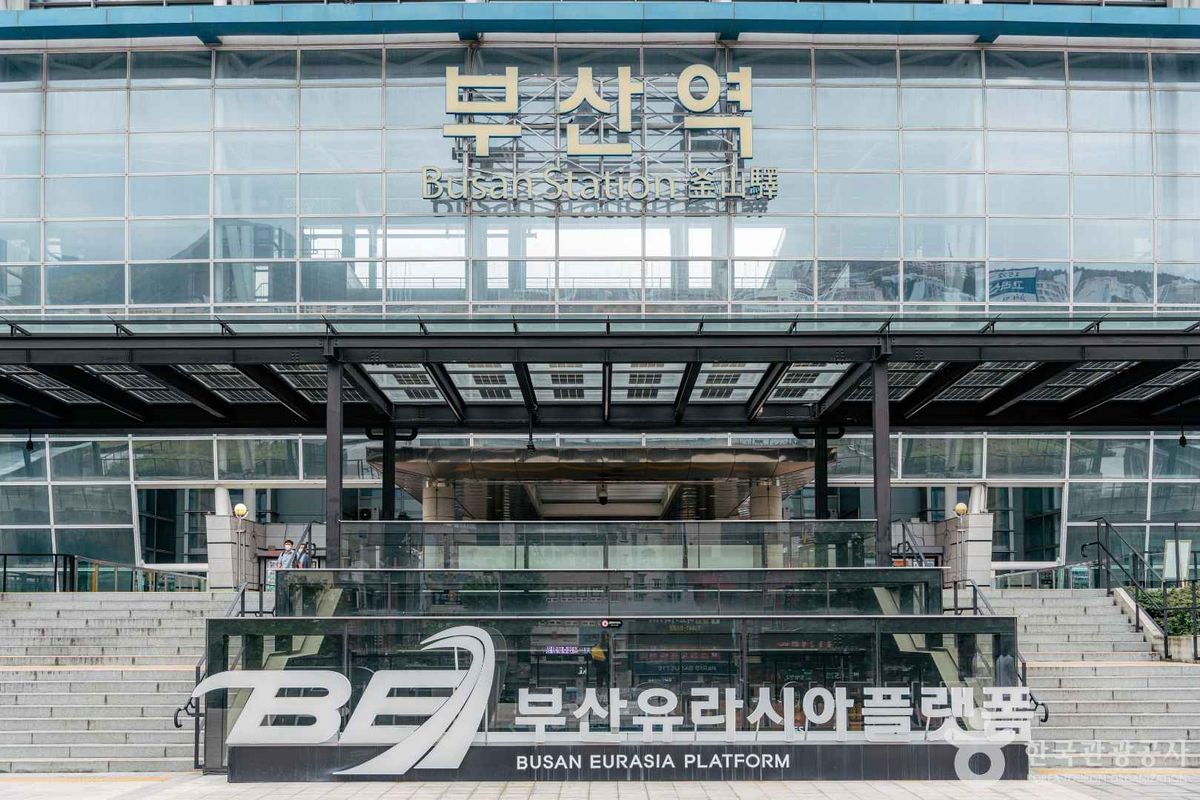
According to VISITKOREA, the Busan Port International Passenger Terminal is a 10 to 15 minute walk from Busan Station, which has KTX and SRT trains and subway Line 1. The same page, updated October 8, 2026, lists Busan-Fukuoka (Korea Ferry), Busan-Shimonoseki (Pukwan Ferry), Busan-Osaka, Hitakatsu and Izuhara on Tsushima (PanStar), and more Tsushima routes run by Daea Express Shipping and Starline. We confirmed only Camellia Line’s current timetable, so check the other operators’ own sites for theirs.
About the old high-speed ferry
Older travel articles still describe JR Kyushu’s high-speed ferry between Hakata and Busan. The service was suspended in August 2024 after the company was found to have kept sailing with a flooding problem, and Nikkei reported on December 23, 2024 that JR Kyushu gave up on resuming it and would withdraw. A Fukuoka news site reported in April 2025 that JR Kyushu had sold the Queen Beetle to a Busan operator. We found no report of the service restarting. Treat any article that quotes Beetle times and fares as outdated.
From Gimhae Airport to the city
Gimhae International Airport is outside the central city. Visit Busan describes it as about an hour’s ride from downtown, and VISITKOREA’s Traditional Chinese page gives these options:
| Method | What it involves |
|---|---|
| Light rail plus subway | Take the Busan-Gimhae Light Rail from the airport station, then change to subway Line 2 at Sasang. About 30 minutes to Seomyeon, 50 to Gwangalli and 70 to Haeundae |
| Airport bus | Boards at Platform 3, between Exits 2 and 3 on the international terminal’s first floor. No cash or transit cards on board, so buy a ticket in advance at the ticket booth near Exit 4. Routes serve Seomyeon and Bujeon, and Haeundae and Gijang |
| Taxi | Stand on the second floor, across from the bus stop. Cash, credit cards and transit cards are accepted. About 40 minutes to the Bujeon Station and Seomyeon area, about 70 minutes to Gwangalli and Haeundae |
The light rail charges ₩1,300 for one zone or ₩1,500 for two with a transit card and runs from 5:00 to 24:00, according to Humetro. Transfers between light rail and subway within 30 minutes (some timed connections allow an hour) get a discount, but only with a transit card, not with single-use tickets. Visit Busan notes that model and large taxis cost about 50% more than regular taxis. Check the airport website for bus times and fares, which change.
Getting around Busan and paying
Busan’s subway and city buses accept transit cards. Visit Busan says the official card is the Hanaro card, but Mybi, T-money, Cash Bee and post-paid cards also get transfer discounts, so a T-money card bought in Seoul works. Our T-money and subway guide explains the card options.
- Subway fares with a transit card: ₩1,600 for one zone and ₩1,800 for two, per Humetro. A single-use QR ticket costs ₩1,700 and ₩1,900.
- A one-day pass bought in the Busan Metro app costs ₩6,000 and covers unlimited rides on the day of sale. A three-day pass is ₩13,000. Neither works on the light rail or the Donghae Line, so the airport light rail is a separate payment.
- The day pass pays for itself at about four subway rides a day, so it suits a packed sightseeing day.
For your overall budget, the trip budget tool shows typical daily costs, and the money guide covers cards and cash.
Choosing an area
| Area | What it is like | Good for |
|---|---|---|
| Haeundae | Long white-sand beach, Dongbaek Island, night views from The Bay 101 | Travelers who want to be by the sea |
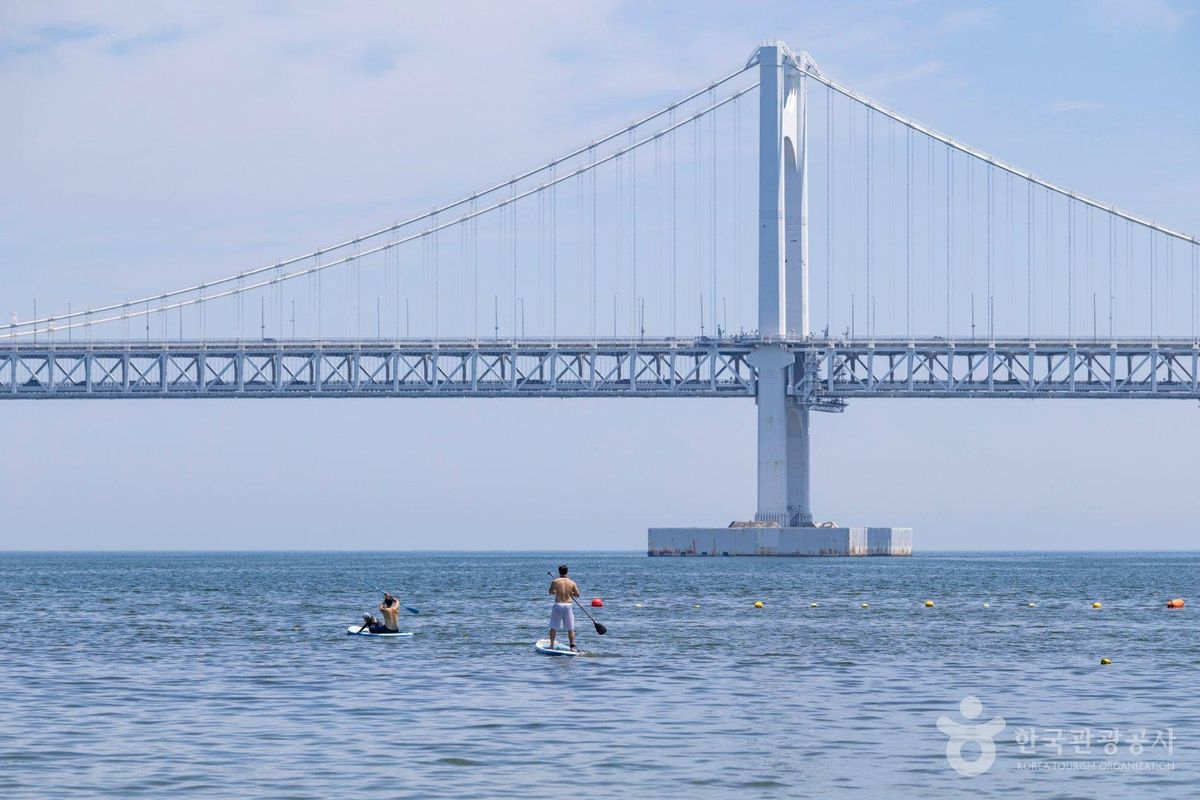
| Gwangalli | Beachfront cafés and views of the Gwangan Bridge | Cafés and night views |
| Seomyeon | A large interchange for subway Lines 1 and 2 | Easy transit, our observation rather than an official recommendation |
| Nampo-dong | Gukje Market, Bupyeong Kkangtong Market, Yongdusan Park with Busan Tower | Markets and the old town |
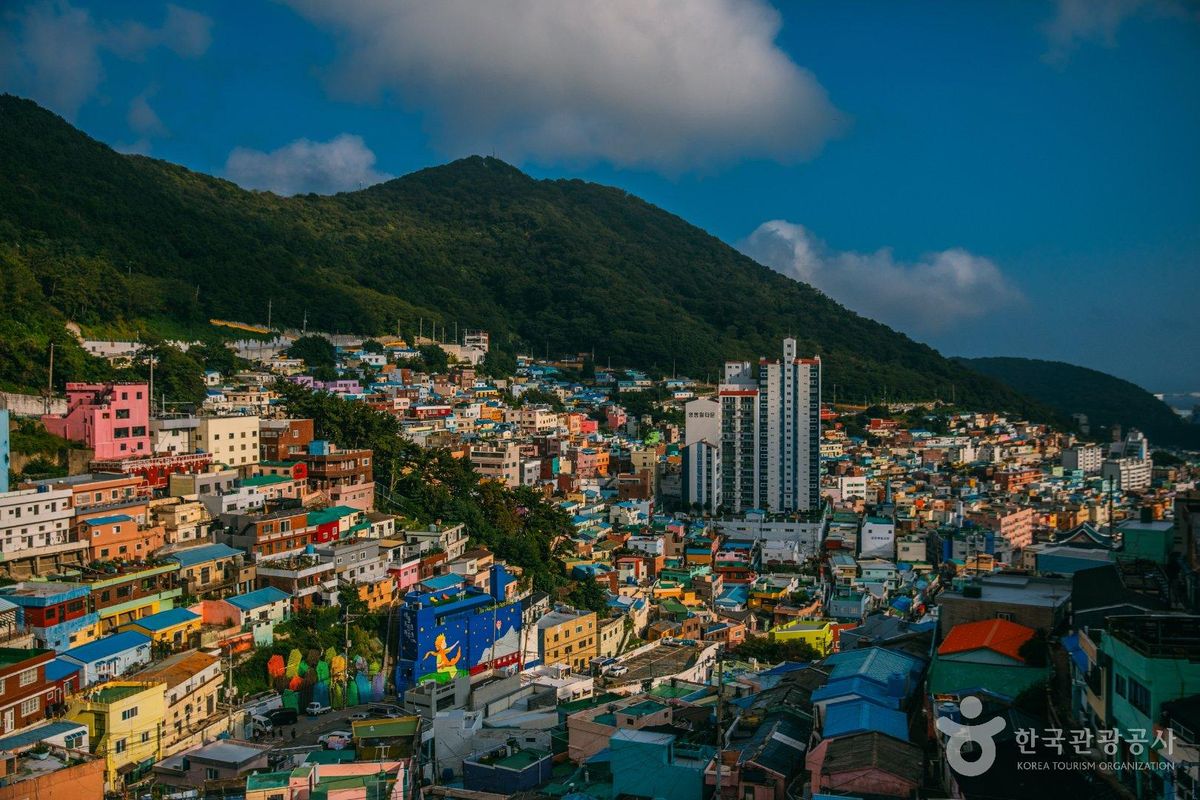
| Gamcheon Culture Village | Pastel houses on a hillside | Photography and a walk |
- Haeundae. Visit Busan describes a 1.5 km beach, with Dongbaek Island at its end, linked by a bridge, and a coastal walking path. At night you can see the Marine City skyline from The Bay 101. From Haeundae Station on Line 2, Exit 5, the beach is about a 15-minute walk. A sand festival runs in May and June, and the Busan Sea Festival in July.
- Gwangalli. Cafés line the shore and the Gwangan Bridge is the landmark, according to Visit Busan’s two-day course.
- Seomyeon. It is close to the airport by light rail and subway, around 30 minutes. That it suits a first night is our reading.
- Nampo-dong area. Visit Busan calls Gukje Market a market with a food alley and a vintage clothing street, and Bupyeong Kkangtong Market a market known for food, with a night market. Yongdusan Park nearby has Busan Tower, with views over the city and harbor.
- Gamcheon Culture Village. Entry is free. It is open daily from 9:00 to 18:00 from March to October and 9:00 to 17:00 from November to February, with no closing day. From Goejeong or Toseong Station on Line 1, Exit 6, change to a village bus and get off at Gamjeong Elementary School, then walk about five minutes. People live in the village, so Visit Busan asks visitors to be quiet and not to fly drones.
Two and three day plans
Visit Busan’s two-day course covers the west side on day one (Taejongdae, Songdo Beach, Gamcheon, Gukje and Kkangtong markets, Yongdusan Park) and the east side on day two (Gwangan Bridge, Haeundae Beach, the Dongbaek coastal path and Nurimaru APEC House, Dalmaji Road, Songjeong, Haedong Yonggungsa Temple). Here is one way to scale that, which is our suggestion rather than an official itinerary.
| Length | Suggested shape |
|---|---|
| 1 night, 2 days | One side only. For example, day one: Gamcheon, a Nampo market and Yongdusan Park. Day two: half a day at Gwangalli or Haeundae |
| 2 nights, 3 days | West side on day one, east side on day two, and a flexible third day near the airport or your route home |
| 3 nights, 4 days | The two days above, plus a day for places farther from the center, such as Songjeong or Haedong Yonggungsa |
Early and late flights limit transport. The light rail runs from 5:00 to 24:00, so plan your airport trip the day before an early departure. For help choosing a base, our where to stay guide explains how to check a listing.
Before you go
- Check entry steps in the K-ETA guide and the e-Arrival Card guide.
- Learn how to take a taxi in taxis in Korea, and set up map apps with the Naver Map and KakaoMap guide.
- Check clothing for your dates with the weather by month tool.
- If you plan to arrive in Seoul first, our Incheon and Gimpo airport guide covers the airport side.
- For help, the Korea Tourism Organization’s 1330 line covers Korean, English, Japanese and Chinese, and Visit Busan lists a Busan tourist information line at 051-120 on weekdays 8:30 to 18:30.
FAQ
Is there still a high-speed ferry from Fukuoka to Busan?
No. JR Kyushu’s service was suspended in August 2024 and the company announced its withdrawal on December 23, 2024. The Hakata-Busan ferry we could confirm in November 2026 is Camellia Line’s.
Is one night enough for Busan?
It works if you choose one side of the city. Busan’s sights are spread out, so one night on the west side (Nampo-dong and Gamcheon) or the east side (Gwangalli and Haeundae) keeps you from spending the trip in transit.
How long does it take to go from Gimhae Airport to Haeundae?
VISITKOREA gives about 70 minutes by light rail and subway, and about 70 minutes by taxi. Traffic and transfers change this.
Can I use the subway day pass on the airport light rail?
No. Humetro says the day and three-day passes cannot be used on the Busan-Gimhae Light Rail or the Donghae Line.
How long is the KTX from Seoul to Busan?
KORAIL lists 2 hours 17 minutes as the shortest KTX-Cheongryong time. Trains with more stops take longer. KORAIL says KTX fares fell by about 10% on average after the 2026 merger of KTX and SRT booking, and exact prices appear at booking.
How far ahead can I book the KTX?
VISITKOREA’s train page, updated in August 2026, says sales open one month before departure. KORAIL’s October 8, 2026 notice says that, to make booking easier for foreign passengers, the window grew to two months from October 1. Check the KORAIL+ app for your date.
Will people speak English or Japanese?
In major tourist areas there is some English and Japanese information, but do not assume staff speak it. See the Naver Map and KakaoMap guide for setting up apps.
This is an unofficial guide based on official information. It is not affiliated with any airline, ferry company, KORAIL, the City of Busan or the Korea Tourism Organization, and does not recommend any operator. Fares, schedules and hours change, so confirm with the official source before you book.