Jeonse, wolse and banjeonse
Korean housing has a rental system you will rarely see elsewhere:
- Jeonse (전세): you hand the landlord a large lump-sum deposit, often a big share of the home’s value, and pay no monthly rent. The full deposit is returned when the lease ends.
- Wolse (월세): a smaller deposit plus monthly rent, closer to renting in most countries.
- Banjeonse (반전세): anything in between, with a sizable deposit and lower rent.
Landlords and tenants often move between these by trading deposit for rent. The rate used for that trade is the conversion rate (전월세 전환율). This calculator shows:
- the monthly rent if part of a deposit is converted into rent,
- the extra deposit needed to reduce or remove rent,
- how rent changes if the deposit goes up or down by a set amount,
- whether the rate exceeds the legal cap, and the maximum rent at the cap,
- a yearly cost comparison that includes the interest your deposit could have earned.
The legal cap on conversion
Under Article 7-2 of the Housing Lease Protection Act, when all or part of a deposit is converted into monthly rent, the rent may not exceed the converted amount multiplied by the lower of:
- 10% a year, or
- the Bank of Korea base rate + 2 percentage points (Enforcement Decree, Art. 9).
The base rate was set at 3.00% on August 27, 2026, so the cap is currently 5% a year. The Bank of Korea decides the rate eight times a year, and the next decision is on October 22, 2026. If it changes, update the base rate field and the cap is recalculated.
When does the cap apply? To an existing lease: when deposit is converted into rent during the lease or at renewal. A brand-new lease with a new tenant is generally understood to follow whatever both sides agree. The cap also limits only the deposit → rent direction. If you paid rent above the cap, you can claim back the excess (Art. 10-2), and terms that are worse for the tenant than the law allows are void (Art. 10).
Formula and example
Monthly rent = converted deposit × conversion rate ÷ 12
Extra deposit = rent removed × 12 ÷ conversion rate
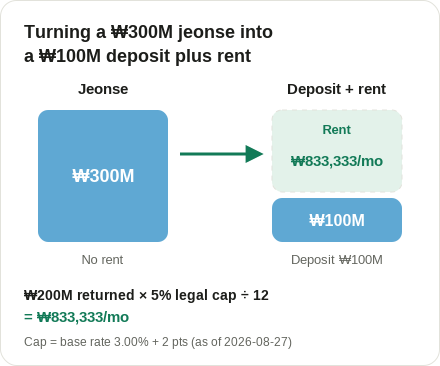
Example: a ₩300 million jeonse becomes a ₩100 million deposit plus rent.
- Converted amount: ₩200,000,000
- At the 5% cap: 200,000,000 × 5% ÷ 12 = ₩833,333 a month
- Yearly rent: ₩9,999,996
Going the other way, removing ₩500,000 of monthly rent at 5% needs 500,000 × 12 ÷ 5% = ₩120 million more deposit.
Which is cheaper, jeonse or wolse?
Jeonse looks free, but the deposit is money that could otherwise earn interest. A fair comparison adds rent + the deposit’s opportunity cost for a year. With a 3% savings rate in the example above:
| Jeonse ₩300M | Deposit ₩100M + rent ₩833,333 | |
|---|---|---|
| Yearly rent | ₩0 | ₩9,999,996 |
| Deposit opportunity cost (3%) | ₩9,000,000 | ₩3,000,000 |
| Total yearly cost | ₩9,000,000 | ₩12,999,996 |
The rule of thumb: if your savings rate (or expected return) is below the conversion rate, a bigger deposit is cheaper; if it is above, a smaller deposit with rent is cheaper. If the deposit comes from a loan, use the loan’s interest rate instead. The risk of not getting a deposit back is real and is not captured in these numbers.
Protecting your deposit as a foreign tenant
A deposit is often the largest sum a newcomer hands over in Korea, so the legal protections matter:
- Report your new address within 15 days. For registered foreign residents, the report of a change of residence (체류지 변경신고) under the Immigration Act takes the place of the move-in report Koreans make. Do it at the local community service center or immigration office within 15 days of moving.
- Get a fixed date (확정일자) on your lease. Living in the home plus the address report gives you the right to assert your lease against new owners (대항력). Adding a fixed date on the contract gives you priority repayment (우선변제권) if the home is sold at auction.
- Deposit return guarantee. Korea Housing & Urban Guarantee Corporation (HUG) states that individuals, corporations and foreigners named as the tenant on the lease can buy its jeonse deposit return guarantee, provided they meet the two conditions above. Check other HUG products’ eligibility on its site before you rely on them.
Frequently asked questions
Is 5% the market rate?
No, 5% is the legal maximum for conversions within an existing lease. Market rates vary by region and housing type. The Korea Real Estate Board publishes them in its R-ONE statistics, and you can type any rate into the calculator.
Does the cap apply when I sign a new lease?
Generally not. The cap protects tenants in an existing lease from having their deposit converted into rent at a high rate. For a new contract, the deposit and rent are what you and the landlord agree on.
Is my data saved?
No. The calculation runs in your browser and nothing you enter is sent or stored.