What is a pyeong?
If you are looking for a place to live in Korea, you will hear sizes like “a 24-pyeong officetel” or “a 34-pyeong apartment”, while the listing itself shows 84 m². Pyeong (평) is a traditional unit of floor area: a square with sides of 6 ja (about 1.818 m). Korea’s Act on Metrology makes the square meter the legal unit, so ads and contracts must use m², but pyeong is still how most people talk about homes.
This converter does three things:
- Type a number into either the m² box or the pyeong box and the other updates immediately.
- Enter a room’s width and length in meters to get the area in both units.
- Enter the exclusive and supply areas from a listing to get the exclusive ratio and the pyeong for each.
Everything is calculated in your browser. Nothing you type is sent anywhere.
The formula
Under the traditional definition, 1 ja = 10/33 m, which gives exact values:
| Direction | Formula | Example |
|---|---|---|
| m² → pyeong | m² × 0.3025 | 84 m² × 0.3025 = 25.41 pyeong |
| pyeong → m² | pyeong × 3.3058 (= pyeong ÷ 0.3025) | 34 pyeong ≈ 112.40 m² |
1 pyeong = 400/121 m² ≈ 3.3058 m², and 1 m² = 0.3025 pyeong exactly. Many people divide by 3.3 in their head. That is close, but it overstates the result slightly (84 m² ÷ 3.3 = 25.45 instead of 25.41), and the gap grows with size.
Exclusive area vs supply area
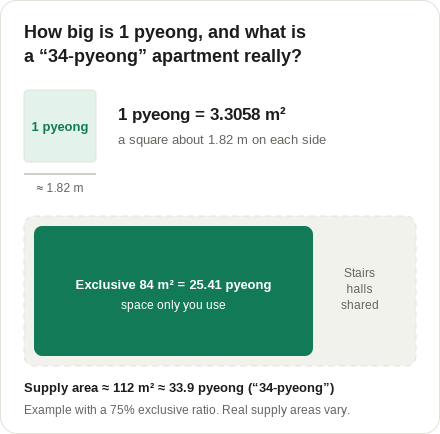
The most confusing part of Korean apartment sizes is which area the number refers to. The same home can be described with numbers almost 10 pyeong apart.
| Term | What it includes | Where you see it |
|---|---|---|
| Exclusive area (전용면적) | Inside your front door only: rooms, living room, kitchen, bathrooms. Measured from the inner line of the walls | Listings and contracts, e.g. “84 m²” |
| Shared residential area (주거공용면적) | Stairs, corridors and entrance halls shared with neighbors | |
| Supply area (공급면적) | Exclusive + shared residential area | The everyday “34-pyeong” number |
| Contract area (계약면적) | Supply area + other shared areas such as underground parking | Common for officetels |
The exclusive ratio is exclusive area ÷ supply area. For apartments it is often around 70–80%, lower for corridor-style buildings. Balconies are usually not counted in the exclusive area, so two homes with the same exclusive area can feel different in size. Officetels are often quoted by contract area, which makes their ratio look much lower.
Common Korean apartment sizes
| Exclusive area | Exclusive pyeong | Supply pyeong (approx.) |
|---|---|---|
| 59 m² | 17.85 | about 22–26 |
| 84 m² | 25.41 | about 32–36 |
| 114 m² | 34.49 | about 43–49 |
84 m² is so common that Koreans call it the “national size”. A widely cited reason is the Housing Act’s national housing size limit of 85 m² of exclusive area per household, which affects housing programs and taxes.
Frequently asked questions
Is a 34-pyeong apartment 34 × 3.3 m² of living space?
No. When people say “34 pyeong” they almost always mean supply area, which includes shared stairs and corridors. The space inside the unit is closer to 25 pyeong (about 84 m²). Check the exclusive area in the listing before you compare prices or sizes.
How do I convert a price per pyeong to price per m²?
Multiply by 0.3025. A price of ₩30,000,000 per pyeong is ₩9,075,000 per m². To go the other way, multiply the price per m² by 3.3058. Also check whether the price is per exclusive or per supply area.
Can I measure a room myself?
Yes. Measure width and length in meters and enter them above. A 3.3 m × 4 m room is 13.2 m², or about 3.99 pyeong. Built-in closets and uneven walls make the usable space a little smaller.